Who Governs Albania?
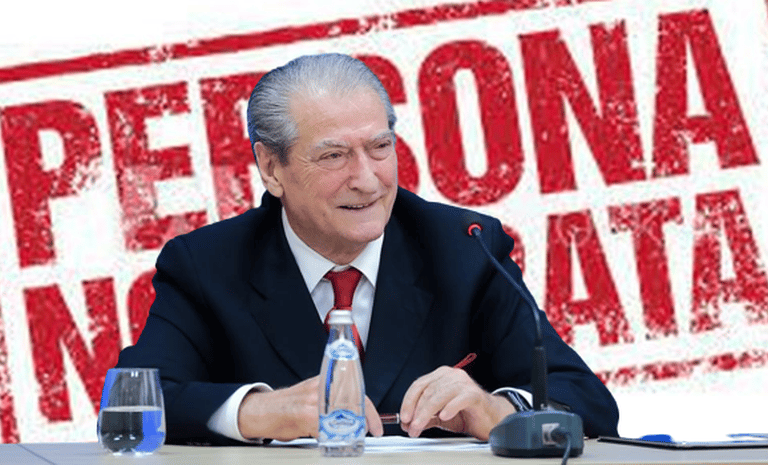
The lifting of Sali Berisha's U.S. designation raises a question larger than one politician: why do foreign judgments continue to shape political legitimacy in a sovereign democracy?

Who Governs Albania?
The lifting of Sali Berisha's U.S. designation raises a question larger than one politician: why do foreign judgments continue to shape political legitimacy in a sovereign democracy?
By Spartak Fikaj
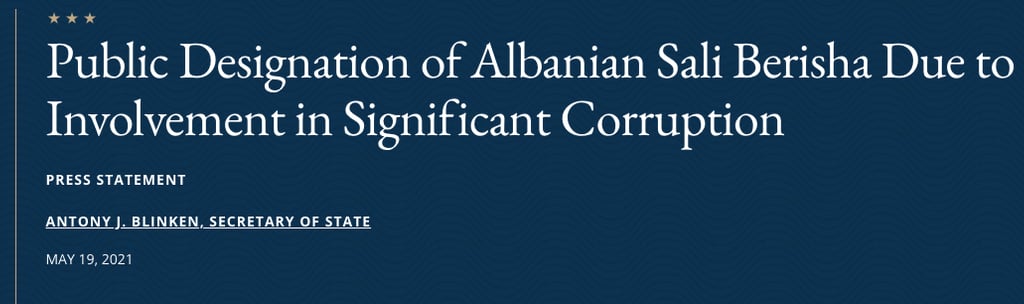
In May 2021, one of the most consequential political judgments in Albania was delivered not by an Albanian court, not by the Albanian Parliament, and not by Albanian voters. It came from Washington. When the United States designated former president and prime minister Sali Berisha and his immediate family under Section 7031(c) of the U.S. State Department's anti-corruption framework, the decision reverberated through Albanian politics with a force few domestic institutions could match. The designation did more than restrict travel. It fractured the country's largest opposition party, altered political alliances, reshaped leadership battles, and became a symbol through which many Albanians interpreted broader questions of corruption, accountability, sovereignty, and democratic legitimacy.
Five years later, Washington has quietly changed course. The United States has granted waivers lifting the restrictions imposed on Berisha and his family, citing what the State Department describes as a "compelling national interest." Yet the most important question raised by this reversal is not whether Berisha can once again board a flight to New York or Washington. It is why a foreign government's judgment carried such extraordinary weight over Albanian political life in the first place, and what that reveals about the unfinished nature of Albania's democratic transition.
For decades, the relationship between Albania and the United States has occupied a unique place in the country's political culture. No foreign power enjoys comparable levels of trust among Albanians. American support during the Kosovo crisis, consistent backing for Albania's Euro-Atlantic integration, and Washington's long-standing role as a strategic partner have created a political reality in which statements originating from the U.S. government often carry moral authority beyond their formal diplomatic significance. This influence has frequently extended beyond foreign policy and into the domestic political arena, where American positions have shaped public perceptions, political strategies, and even leadership contests.
The Berisha designation represented perhaps the clearest example of that phenomenon. When the State Department accused the former Albanian leader of involvement in significant corruption, the decision immediately transcended its legal scope. It became a political instrument. Opponents treated it as proof that Berisha no longer possessed the legitimacy required to lead the opposition. Supporters viewed it as an unacceptable foreign intervention in domestic politics. What followed was not merely a disagreement about one politician's future but a fundamental debate about who possesses the authority to determine political legitimacy in Albania.
The consequences were profound. The Democratic Party entered one of the most turbulent periods in its history. Lulzim Basha's decision to exclude Berisha from the parliamentary group triggered a conflict that ultimately split the party into rival camps. The battle consumed years of opposition energy and transformed internal disagreements into an existential struggle over the party's future direction. At its core stood a simple but politically explosive question: should Albania's largest opposition force organize itself around the preferences of its own membership or around the expectations of its most important international ally?
The answer proved more complicated than many expected. Despite the weight of American pressure, Berisha did not disappear from political life. On the contrary, he gradually reasserted control over the Democratic Party, defeated internal challengers, and returned to the center of Albania's political landscape. The outcome demonstrated an uncomfortable reality frequently overlooked in discussions of foreign influence. External pressure can shape political events. It can alter incentives, influence narratives, and affect institutional behavior. Yet it cannot necessarily replace domestic political legitimacy. In some cases, it may even strengthen those it seeks to marginalize by allowing them to present themselves as victims of outside interference.
This paradox lies at the heart of the Berisha story. The United States possessed sufficient influence to trigger a political earthquake within the Albanian opposition. It did not possess sufficient influence to remove Berisha from Albanian politics. That distinction matters because it reveals the limits of foreign power, even in countries where international actors enjoy exceptional prestige.
The recent American reversal therefore raises questions extending far beyond one individual. The State Department has not publicly explained what changed between 2021 and 2026. The allegations that formed the basis of the original designation have not been formally withdrawn. The corruption case involving Berisha in Albania remains unresolved. The United Kingdom continues to maintain restrictions against him. Yet Washington now argues that lifting the designation serves a compelling national interest.
Diplomatic language is rarely accidental. The phrase itself invites scrutiny because it suggests that broader strategic considerations may now carry greater weight than the symbolic value of maintaining the restriction. Whether those considerations relate to regional stability, broader Balkan dynamics, changing foreign policy priorities, or other factors remains unclear. What is clear is that the decision reflects the increasingly complex relationship between values-based diplomacy and geopolitical pragmatism.
This complexity becomes even more apparent when viewed against the backdrop of recent controversies involving U.S.-Albanian relations. Few cases have shaken public confidence more than the Charles McGonigal affair. The former senior FBI counterintelligence official pleaded guilty in the United States to charges related to concealed financial arrangements and undisclosed foreign contacts. Court documents revealed connections involving Albanian-linked business interests and meetings connected to political developments in the region. While there is no evidence directly linking the McGonigal case to either Berisha's designation or its removal, the scandal profoundly altered public perceptions regarding influence, access, and the intersection of politics and intelligence.
For many Albanians, the McGonigal affair introduced a new degree of skepticism into discussions involving foreign intervention and political influence. It did not invalidate previous American decisions. Nor did it prove the existence of hidden agendas. What it demonstrated, however, was that international relationships are often more complicated than public narratives suggest. The assumption that foreign judgments exist entirely outside political calculation became more difficult to sustain.
At the same time, Albania itself is changing. The political generation that emerged from the collapse of communism continues to dominate public life. Both Sali Berisha and Prime Minister Edi Rama remain defining figures within Albanian politics, despite representing different eras and political traditions. Yet growing sections of the public appear increasingly frustrated by a political system that continues to revolve around personalities rather than institutions.
Recent protests concerning corruption, governance, environmental controversies, and major development projects have reflected this broader frustration. Particularly notable has been public opposition surrounding proposed investment projects linked to Jared Kushner, the son-in-law of former U.S. President Donald Trump. Demonstrators have raised concerns about transparency, environmental protection, and political accountability. One slogan heard repeatedly during protests — "Rama in prison, Berisha in prison" — captures a sentiment that transcends traditional party loyalties. For many younger Albanians, the central issue is no longer choosing between rival political camps but questioning a system that appears incapable of renewing itself.
This generational tension may ultimately prove more significant than any individual political controversy. More than three decades after the fall of communism, Albania continues to wrestle with a transition that remains incomplete. Democratic institutions have strengthened in many respects, yet politics often remains highly personalized. Public trust in institutions frequently lags behind trust in individuals. Leadership changes occur less through generational renewal than through prolonged struggles among established political figures.
Against this backdrop, the Berisha episode becomes a case study in the broader challenge facing Albanian democracy. It reveals a political system in which foreign approval can carry enormous domestic significance, yet where domestic political realities continue to resist external control. It demonstrates both the influence and the limitations of international actors. Most importantly, it exposes the unresolved question of where legitimacy ultimately comes from.
Can a sovereign democracy rely on foreign governments to validate or invalidate its political leaders? Should diplomatic designations carry greater practical consequences than domestic institutional processes? Can democratic accountability be strengthened through external pressure, or does such pressure risk weakening local institutions by encouraging dependence on outside judgments?
These questions extend beyond Albania. Across the Western Balkans, governments and opposition movements alike operate within a complex environment shaped by international organizations, foreign governments, donor networks, security partnerships, and geopolitical competition. The Russian invasion of Ukraine has further intensified the strategic importance of the region. NATO concerns, European Union enlargement, energy security, foreign investment, and competition with Russia and China increasingly influence policy decisions throughout Southeast Europe.
In such circumstances, geopolitical considerations inevitably intersect with democratic values. Governments pursue stability while simultaneously promoting reform. Strategic interests coexist with anti-corruption agendas. Diplomatic priorities shift in response to changing realities. The challenge lies in ensuring that these shifts do not undermine public confidence in the principles they are intended to support.
The lifting of Berisha's designation therefore represents more than a personal political victory or defeat. It serves as a mirror reflecting deeper tensions within Albanian society and within the broader relationship between small democracies and powerful international partners. It highlights the persistent influence of foreign actors while simultaneously exposing the resilience of domestic political forces. It demonstrates how international decisions can shape national politics while also revealing the limits of that influence.
Ultimately, the most important lesson may be that Albania's democratic future cannot be determined in Washington, Brussels, London, or any other foreign capital. International partnerships matter. Strategic alliances matter. Foreign support matters. But lasting democratic legitimacy can only emerge from institutions trusted by citizens, political competition governed by rules rather than personalities, and a public sphere capable of holding all leaders accountable regardless of foreign endorsement or condemnation.
The American verdict has changed. The deeper challenge remains. Albania's future will not be decided by travel bans, waivers, diplomatic designations, or foreign judgments. It will be decided by whether the country can finally complete the transition from a politics dominated by personalities to a democracy grounded in institutions.
That is a question no foreign government can answer.
Only Albanians can.
Note: The themes of foreign influence, political accountability, and U.S.-Albanian relations discussed in this article intersect with research explored in Corruption at the Highest Levels: Albania/USA/Russia: The Shocking Truth Behind the Rama-McGonigal Scandal by Spartak Fikaj.