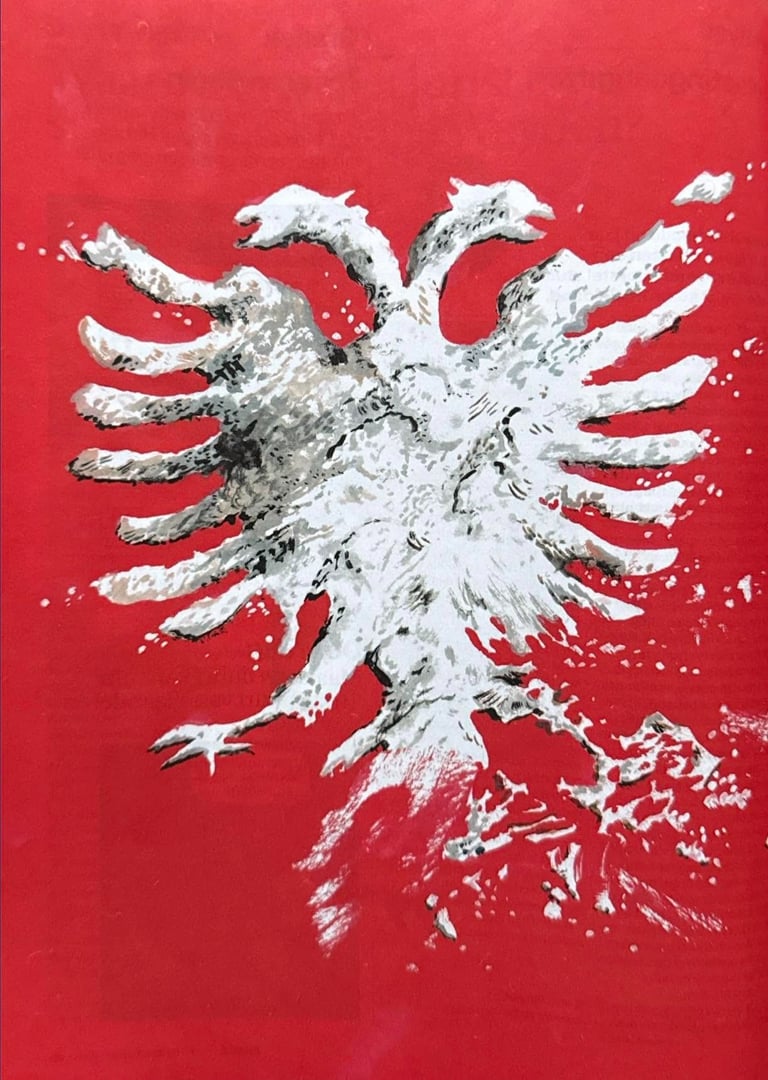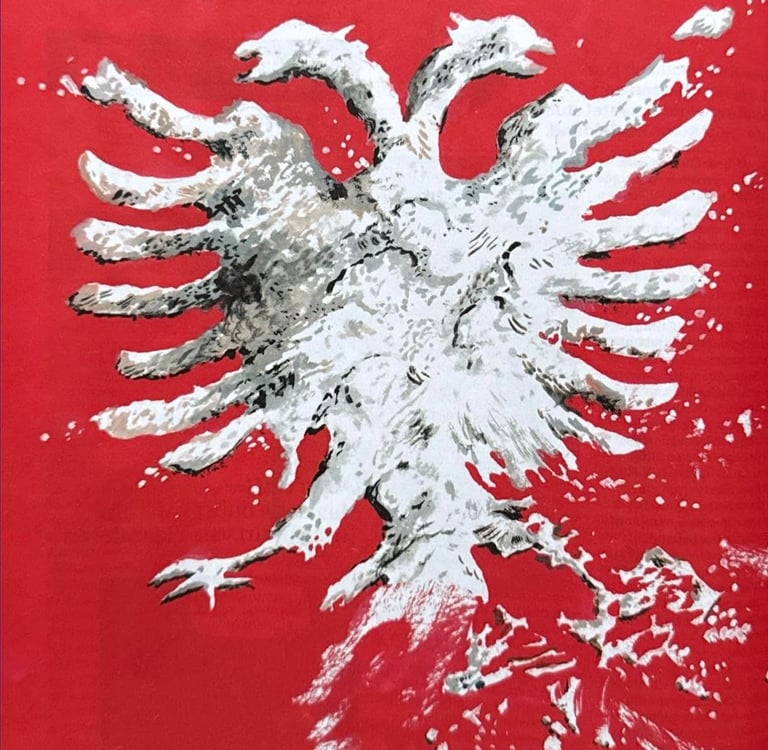
When a National Symbol Becomes a Criminal Symbol
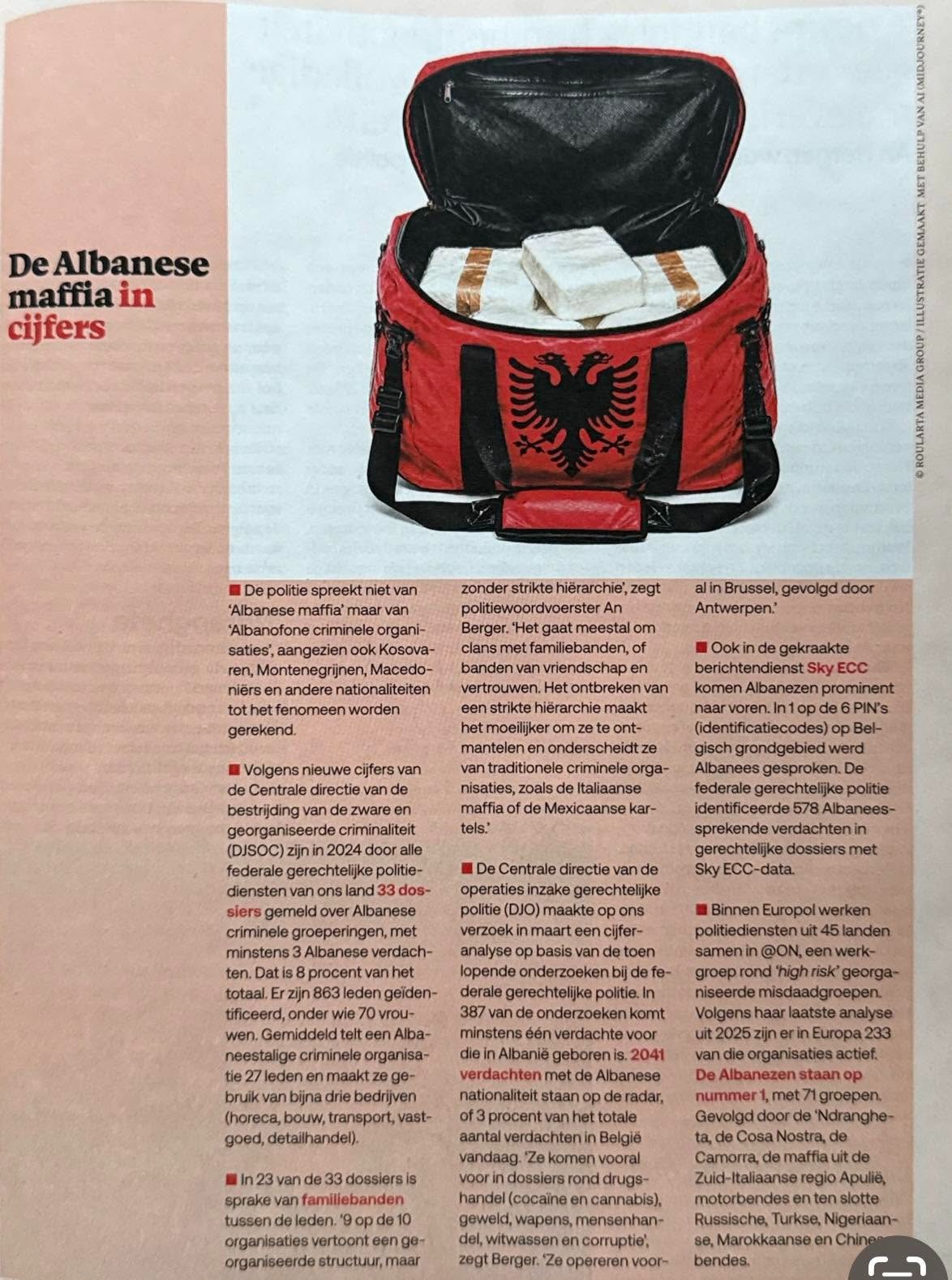
At the centre of the magazine cover appeared one of the most recognizable national symbols in Europe: the Albanian double-headed eagle. Yet it was presented not as a historical emblem, nor as a symbol of a nation, but in a visual composition associated with cocaine trafficking and organized crime.
When a National Symbol Becomes a Criminal Symbol
On a recent morning in Brussels, an Albanian-born physician picked up a magazine on his way to work. Like thousands of other professionals of Albanian origin across Belgium, he has spent years building a life here: studying, paying taxes, raising a family and contributing to the society he now calls home.
What caught his attention was not the headline.
It was the image.
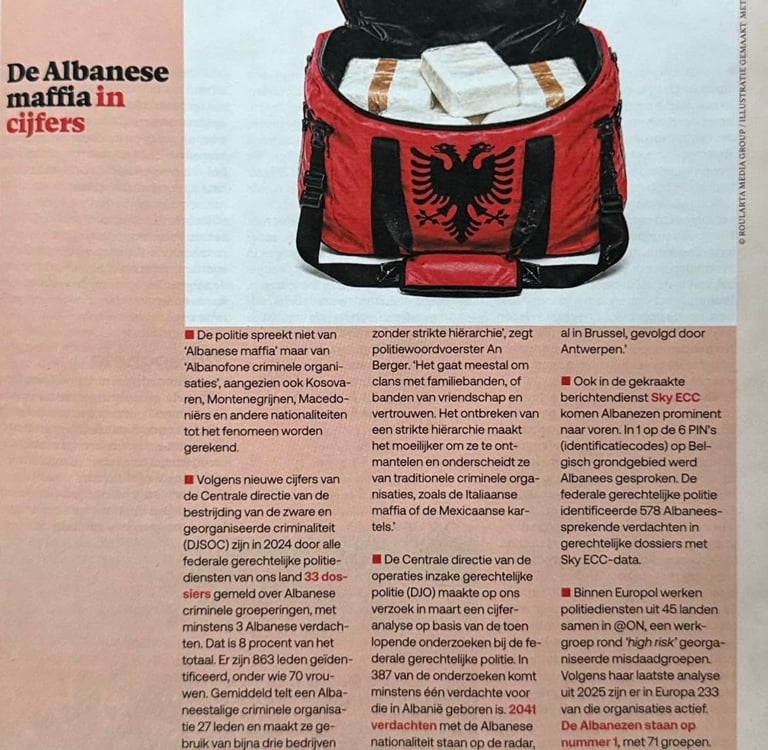
At the centre of the magazine cover appeared one of the most recognizable national symbols in Europe: the Albanian double-headed eagle. Yet it was presented not as a historical emblem, nor as a symbol of a nation, but in a visual composition associated with cocaine trafficking and organized crime.
The issue immediately raised a question that extends well beyond Albania, beyond Belgium and beyond the particular criminal investigation that inspired the publication.
Where does legitimate reporting end and symbolic association begin?
The distinction matters because democratic societies rely on two principles that occasionally come into tension with one another. The first is the freedom of the press to investigate criminal activity wherever it exists and to report uncomfortable truths without fear or favor. The second is the equally important principle that responsibility for criminal acts belongs to individuals and organizations, not to entire peoples.
No serious observer disputes that organized crime exists. Nor should anyone object to rigorous investigative journalism. Criminal networks operating across Europe represent a genuine threat to public security, economic integrity and the rule of law. If law-enforcement authorities identify networks involving individuals of Albanian origin, journalists have every right—and arguably a duty—to report those findings.
Indeed, democratic societies depend upon such reporting.
The question is not whether organized crime should be investigated.
The question is how it should be illustrated.
Visual language carries a particular power because it operates differently from written language. Readers may debate a headline or scrutinize an article's details, but images often leave a more immediate and enduring impression. Long after statistics, quotations and legal nuances have been forgotten, a symbol may remain fixed in memory.
For this reason, editorial choices involving national symbols deserve careful consideration.
A national flag is not merely a graphic device. It represents a shared history, collective memory and civic identity extending far beyond any particular government, political movement or group of individuals. The Albanian double-headed eagle, like the tricolour of France, the lion of Belgium or the eagle of Germany, carries meanings accumulated across centuries.
When such symbols are placed at the centre of imagery associated with narcotics, violence or criminal enterprise, the message received by readers may extend beyond the specific facts of the investigation itself.
Defenders of such editorial choices might argue that the image serves a legitimate descriptive purpose. Criminal organizations frequently possess linguistic, cultural or national connections. Visual shorthand, they may contend, helps readers quickly understand the subject matter. In an increasingly competitive media environment, strong imagery also attracts attention and encourages engagement with stories of public importance.
These arguments deserve to be taken seriously.
Freedom of expression necessarily includes the freedom to publish images that some readers may find uncomfortable, provocative or even offensive. A press constrained by fear of causing offence would struggle to fulfil its democratic function.
Yet editorial freedom does not eliminate the need for editorial judgment.
The most important question is not whether a publication has the right to use a national symbol in this manner. It almost certainly does.
The more interesting question is whether doing so advances public understanding.
There is a difference between identifying the origin of individuals involved in criminal investigations and transforming a national emblem into a visual metaphor for criminality itself. One approach informs. The other risks simplifying.
History offers numerous examples of why that distinction matters.
Modern Europe emerged from centuries marked by suspicion toward minorities and by the temptation to explain complex social problems through collective labels. Different communities—among them Jews, Roma, Armenians and many others—have experienced periods in which public discourse blurred the line between individual conduct and collective identity.
The lesson drawn from those experiences was not that differences should never be discussed. Nor was it that journalists should avoid difficult subjects.
Rather, it was that democratic societies function best when individuals are judged according to their actions rather than through symbolic associations attached to larger communities.
This principle remains particularly relevant in an age dominated by visual communication. Images travel faster than explanations. Symbols often reach audiences who never read the accompanying article. The more emotionally powerful the image, the greater the responsibility to consider its broader implications.
None of this requires censorship.
Nor does it require journalists to ignore uncomfortable realities.
It simply invites a discussion about proportion, context and precision.
The strongest journalism illuminates complexity rather than reducing it. It distinguishes between criminal networks and the societies from which individual criminals may emerge. It resists the temptation to substitute symbolism for analysis. Most importantly, it recognises that public trust depends not only on exposing wrongdoing but also on describing it with accuracy and restraint.
In the end, the debate surrounding such imagery is not really about Albania. Tomorrow it could concern another nationality, another minority or another community.
The deeper issue is whether democratic journalism can continue to uphold one of its most valuable disciplines: the refusal to confuse identity with guilt.
A free press must remain free to investigate criminal networks wherever they operate. But it should be equally careful when choosing the symbols through which those investigations are presented. For once a national emblem becomes a shorthand for criminality, the story ceases to be only about crime; it becomes, however unintentionally, a story about belonging. And in a democracy, belonging should never have to stand trial for the actions of others.