The Unmaking of a Mosaic: How a Modern Nation Erased Its Own Minorities
An investigation into a century of quiet engineering — censuses, colonies, and citizenship laws — that turned the polyglot Balkans of Macedonia, Epirus, and Thrace into a "purely Greek" land.
The Unmaking of a Mosaic: How a Modern Nation Erased Its Own Minorities
An investigation into a century of quiet engineering — censuses, colonies, and citizenship laws — that turned the polyglot Balkans of Macedonia, Epirus, and Thrace into a "purely Greek" land.
A Town That Burned on the Night of Its Liberation
On the evening of June 21, 1913, Greek soldiers entered the town of Kilkis — known to its own residents as Kukuş — and burned it to the ground. Every inhabitant was a Christian, baptized in the Orthodox church, loyal to no sultan. Their only "crime," as later generations of officers would describe it without embarrassment, was that they were Slavic-speaking, and that the town was, in the words of a Greek general who watched it burn, "considered for a long time the most fanatically Bulgarian city." He recorded his own feelings in his memoirs: not regret, but joy — "great joy," he wrote, "not only for the victory, but because Kilkis had long been considered the most fanatically Bulgarian town."
Officially, the fire was an accident of war, or the doing of fleeing residents. Unofficially, a Greek officer named Konstantinos Mazarakis had, days earlier, drawn up a confidential survey of every village and town in the path of the advancing army — graded not by military value but by ethnic and political loyalty. Villages were marked as "fanatically pro-Greek," "Bulgarizing," or "Macedonizing." Some were flagged because their overseers, though employed by Greek landowners, could be trusted to inform on their neighbors. Kukuş was marked for what it was: a town with no Greek-speakers in it at all, and a population that, when given the choice between empires and nations a few years earlier, had not chosen Athens.
Today, every June 21st, the Greek state commemorates the "liberation" of Kilkis. It does not commemorate what stood there before — and on the official map, there is now nothing left to commemorate. Kilkis is Greek. It has always been Greek, says the holiday. The people who actually lived there in 1913 do not appear in the story at all.
This is not a single, aberrant atrocity. It is the opening scene of an extraordinarily long and carefully constructed national project — one that took nearly a hundred years, used the instruments of war only sparingly, and relied far more on something duller and more durable: paperwork. Censuses. Land deeds. School curricula. Passport stamps marked "no right of return." A 1927 decree about citizenship. A secret 1949 cabinet decision that even today sits, heavily redacted, in a state archive that recently refused historians access to a file on the grounds that it touched "the national interest."
Drawing on declassified Greek military and diplomatic archives, court records, and the documented research of historians including Tassos Kostopoulos, Lambros Baltsiotis, Yannis Bonos, and Philippe Gelez — published together in a special dossier of the European Journal of Turkish Studies — a single story emerges from three different corners of Greece: Macedonia, Epirus, and Thrace. It is the story of how a state that publicly insisted, decade after decade, that minorities barely existed within its borders spent that same century in closed-door meetings calculating exactly how many of them there were, and what to do about it.
It is easy to forget, looking at a modern map, how recently these borders were drawn — and how little they corresponded to who actually lived inside them.
In 1912, on the eve of the Balkan Wars, the territory that would become Greek Macedonia held roughly 1.25 million people. Christian Greek-speakers — the population the later national mythology would claim had always been there, "eternally Hellenic" — made up barely 29 percent of it. Muslims of various mother tongues made up well over a third. Slavic-speaking Christians, divided among rival Greek, Bulgarian, Serbian, and an emerging "Macedonian" national allegiance, made up another quarter or more. Sephardic Jews filled the streets of Thessaloniki in numbers that outnumbered both Greeks and Muslims combined in that city alone.
Further south and west, in what is now the Greek prefecture of Thesprotia in Epirus, a different mosaic existed: the Chams, an Albanian-speaking population split between Orthodox Christians and Sunni Muslims, who had lived interwoven with Greek-speaking neighbors for generations, sharing markets, sharing land disputes, sometimes sharing language. The Muslim and Christian Chams were, by the account of Lambros Baltsiotis, frequently impossible to disentangle as a distinct economic class — yet only one of the two communities would eventually need to disappear.
In Thrace, along the new and unstable line separating Greece from Bulgaria and Turkey, demographic policy had already been a contested chessboard for decades — the Ottomans planting refugees as a "defensive wall," the Bulgarians counter-settling the same villages a generation later, each empire treating the local population less as citizens than as ballast to be shifted for strategic weight.
None of these places were imagined by their own founding nationalist theorists as natural extensions of a Greek nation. Internal Greek government memoranda from the 1880s — never meant for public consumption — admit as much in blunt terms. Konstantinos Paparrigopoulos, the father of modern Greek national historiography, wrote confidentially to the Foreign Ministry in 1884 that north of a line running through Kastoria, Naousa, Thessaloniki, Serres, and Drama, "the Greek language is spoken nowhere as a native tongue." The diplomat Ion Dragoumis, one of the architects of Greek irredentism, said the same thing in his own private notebooks in 1903. Publicly, both men's governments spoke of "eternal Hellenism." Privately, they were drawing maps of where Greek did not exist, and planning how to change that.
The First Blueprint: Buy the Land, Build the Nation
The earliest known plan to engineer the ethnic balance of Macedonia in Greece's favor was not a battle plan. It was a real-estate scheme.
In 1880, a government envoy named Athanasios Eftaxias proposed — in a slim, privately printed pamphlet meant only for a small circle — that wealthy Greek entrepreneurs buy up Ottoman-era chiftlik estates en masse, then use their leverage as landlords to compel the Slavic-speaking tenant farmers who worked that land to assimilate, building Greek-language schools at their own expense as the price of staying on the land. The economics, he calculated, made it nearly free: land and labor were cheap after the devastation of the 1877–78 Russo-Turkish war.
Two decades later, the diplomat Ion Dragoumis refined the idea into something closer to a doctrine. As Greece's consular officer in Serres and later Dedeağaç, he wrote confidential reports proposing the deliberate colonization of contested villages with "pure Greeks" — meaning, explicitly, Greek-speakers — whose presence would anchor the linguistic assimilation of their neighbors, provided the colonists themselves were watched closely enough not to go native. He proposed quietly replacing Slavic-speaking bakers, servants, and shopkeepers in towns with Greek-speaking workers "invited" in without fanfare, and recommended an economic boycott so total it would, in his words, be acceptable to "go as far as violence" to achieve.
The plan only partially worked, and its failures are as revealing as its successes. Banks balked at financing land purchases in a region wracked by guerrilla war. Greek capitalism in 1900 was simply too thin to bankroll a colonization project at scale. And the would-be colonists themselves frequently refused to come: Greek refugees fleeing anti-Greek pogroms in Bulgaria in 1906, explicitly courted by the Greek consul in Thessaloniki as ideal settlers for the contested zone, chose instead to settle in Athens or the fertile plains of Thessaly, anywhere but the volatile frontier they were being recruited to colonize.
Where money and persuasion failed, violence sometimes filled the gap. Greek armed bands — locally raised, only loosely tied to the state — drowned roughly a hundred unarmed Slavic-speaking seasonal laborers in the Aliakmonas River in May 1905. Twenty-five more were killed near Chalkidiki in 1907; a dozen had their throats cut in front of their children near Katerini that same year. A British journalist on the Greek government's payroll later supplied the official rationale in print, comparing the killings to the exclusion of Chinese immigrants from the United States: unarmed laborers, he wrote, were merely "the advance guard of an army of invasion." It was the same logic — demographic encroachment recast as existential threat — that would recur, with minor variations, for the next ninety years.
The Balkan Wars of 1912–13 did, abruptly and violently, what decades of consular scheming could not: they handed Greece a vast new territory and, with it, the wartime cover to begin remaking its population.
Tens of thousands of Muslims and Slavic-speaking Christians fled or were driven from Greek Macedonia in 1912–1915 — by the documented, though long-suppressed, count of Greek official statistics, on the order of 45,000 Slavic-speaking "Bulgarians" and tens of thousands of Muslims before hostilities even ended, with far larger Muslim flight following in the immediate aftermath. Simultaneously, over 161,000 Greek refugees and tens of thousands of Muslims displaced from Bulgarian and Ottoman territory were funneled in to replace them — not randomly, but according to an explicit zoning logic.
A staff officer named Athanasios Exadaktylos drew up the plan only weeks after the fighting stopped. He divided the newly annexed frontier into three zones by religious and ethnic composition and proposed populating each with refugees chosen specifically to "change the ethnic character" of that zone — Greek-speaking refugees from Thrace into the Muslim-majority belt near Drama, Greek-speakers from Meleniko into the Bulgarian-leaning plain near Demir Hissar, and so on. The state, meanwhile, would block displaced Slavic-speaking sharecroppers from returning home at all, on the explicit reasoning — recorded in his own memo — that the rural landless poor were both a national and a social danger, having already absorbed "revolutionary and socialist ideas" from Bulgarian organizers. National loyalty and class control were, from the very beginning, treated as the same problem.
A parallel architecture took shape in Greek Epirus, where the Muslim Chams found themselves systematically squeezed off their own land through a sequence of laws that look, individually, like ordinary postwar bureaucracy and, collectively, like a campaign. Land sales by Muslims were frozen. A 1923 decree permitted expropriation of "abandoned" Muslim plots. In one case, a government committee simply declared the entire town of Paramythia — houses, gardens, everything but the buildings themselves — a single expropriable chiftlik estate, even though much of it consisted of small family gardens that had never functioned as a plantation. Compensation, when it came at all, arrived years late and at token rates — as low as three drachmas per stremma, according to a confidential 1930 report by the Greek government's own minorities inspector, who described Muslims being jailed for failing to pay taxes on land the state had already confiscated from them.
The single largest engineering project of all arrived not from a Greek general's desk but from a peace conference in Switzerland. The 1923 Treaty of Lausanne, brokered in the aftermath of Greece's catastrophic defeat in Asia Minor, mandated the compulsory exchange of populations between Greece and Turkey on the basis of religion alone — Greek Orthodox Christians for Muslims, with narrow carve-outs for Istanbul's Greeks and Western Thrace's Muslims. A parallel, nominally voluntary exchange with Bulgaria followed the 1919 Treaty of Neuilly.
In raw numbers, the transformation was staggering: roughly 355,000 Muslims and 53,000 Bulgarians left Greece; between 1.3 and 1.4 million Greek Orthodox refugees from Turkey and Bulgaria arrived to take their place. More than half of all refugees settled in Macedonia, and the documentary record shows this was not incidental. A March 1924 confidential memo from the Director-General of Colonization in Thessaloniki — addressed to the Ministry of Agriculture and never intended for public eyes — describes the explicit purpose of refugee settlement maps then being drawn: to identify "foreign elements" village by village and insert refugee colonies among them "in such a way that they become from now on completely harmless."
The memo is worth pausing on, because its language so precisely inverts the language Greece used internationally. To the League of Nations and the Mixed Commission overseeing the population exchange, Athens insisted the process was peaceful, voluntary, and administrative. Internally, the same officials were drafting maps that graded villages by their "fanaticism," distinguished "Greeks of doubtful sentiment" from "fanatical Bulgarians," and treated whole communities as security problems to be diluted with colonists.
Refugees themselves frequently became, in effect, an unofficial instrument of expulsion, whether or not that was the state's explicit instruction. A member of the resettlement commission later described what happened on the ground in blunt terms: refugee families moved en masse into Macedonian villages, seized already-ploughed fields, livestock, even kitchenware from the existing Slavic-speaking residents, hurling the word "Bulgarian" at them as an insult while doing it. The pressure to leave was, in the commissioner's own words, "real and very heavy" — even though, under the letter of the Neuilly Convention, the exchange with Bulgaria was supposed to be entirely voluntary.
Some communities tried to resist by proving their loyalty rather than fleeing it. The village of Petrovo sent Athens a telegram in 1924 — preserved in the private archive of the politician Philippos Dragoumis, one of the few Greek officials who actually objected to indiscriminate expulsion — pleading that its men had fought against Bulgarian propaganda under Ottoman rule and now found themselves "persecuted by organs of power" who were using coercive resettlement to drive them into exile anyway. "We are Greeks," the telegram said, "and we prefer to die on Greek sacred soil." The village was spared only because, by chance, the local corps commander had once served in the same consulate that had recruited Petrovo's loyalty a decade earlier and personally intervened. Villages without that kind of personal connection to power had no such luck.
If land was the first battlefield, statistics were the second — and arguably the more important one, because a contested population, once made invisible on paper, could be governed as though it did not exist.
The pattern recurs with almost mechanical regularity across every region and every decade examined here. In 1928, Greece's official census recorded just 81,984 Slavic-speakers in Macedonia. The state's own internal security, school inspection, and military intelligence services — operating in total secrecy from each other, in some cases decades apart — independently estimated the real number at somewhere between 162,500 and 200,000: double to two-and-a-half-times the public figure. The same gulf reappears with eerie consistency for decades afterward. Greece's last census ever to record mother tongue, in 1951, found just over 41,000 Slavic-speakers nationwide. The state intelligence service's parallel, classified count for the single prefecture of Florina alone, conducted in 1954, found 43,546 — more than the entire country's "official" total — and that number climbed again in later internal counts through the 1960s.
The same sleight of hand was performed on the Chams of Epirus. The 1928 census for the region recorded 17,009 Albanian-speaking Muslims. Nationalist authors writing in the following decades, eager to minimize the scale of what had happened to them, manipulated the same 1940 census data downward, in one case to a round and suspiciously tidy 16,661 — achieved, as Baltsiotis documents, by simply omitting the Muslim population of certain villages entirely from the count and reassigning mixed villages' Muslim residents to the Christian column.
This was not merely undercounting. It was an act of erasure with legal teeth, because in both regions, internal government documents graded individuals on a sliding scale — "Greek-minded," "of fluid national consciousness," "fanatically Bulgarian" or "fanatically Slav" — and that grading determined real outcomes: whether your children could enter the civil service, whether your land could be confiscated, whether you would be expelled, and, eventually, whether you would be allowed to keep your Greek citizenship at all.
The Cycle of Revenge and the Massacre That Made a Province "Pure"
In Epirus, the demographic project that had proceeded for two decades through paperwork reached its violent climax during the chaos of the Second World War.
When Italy invaded Greece from Albania in October 1940, Greek authorities responded by arresting and exiling the entire leadership of the Muslim Cham community on the very first day — a decision later historians have called catastrophic in its consequences, since it removed any moderating voice and confirmed, in the community's eyes, exactly how Athens regarded them. Some Chams subsequently collaborated with occupying Italian and German forces; the documented record shows roughly 300 to 450 Christian Greeks were killed in the area during the occupation, mostly attributable to Cham-linked militias and wartime score-settling rather than any organized campaign.
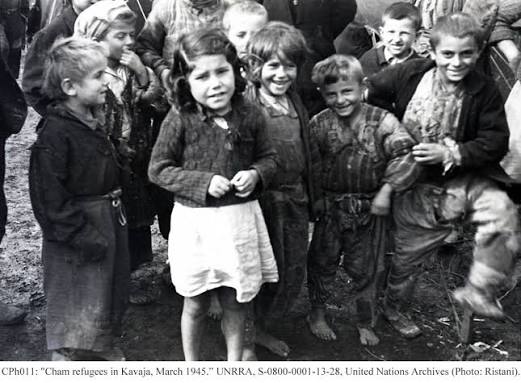
What followed was wildly disproportionate to that toll, and increasingly hard to characterize as anything but a planned expulsion executed under cover of guerrilla war. Starting in June 1944 and continuing into 1945, battalions of the Greek nationalist resistance group EDES — under the command of Napoleon Zervas, a man the postwar Greek state would go on to honor as a hero and reward with a prominent political career — moved through Muslim villages and killed not only surrendering Cham fighters but, methodically, women and children as well. Towns and villages including Karvounari, Parga, Trikoryfo, Filiati, and above all Paramythia, where roughly 300 people were murdered in a single episode, were emptied. By contemporary tallies, more than 1,200 Muslim Chams were killed; some Albanian-language sources put the figure closer to 2,000. The entire Muslim Cham population — numbering well over 20,000 people, a community that had lived in the region for centuries — fled the country by the end of 1944.
What makes the historical record so damning is what happened after the killing stopped. Returning Cham refugees who tried to come back to Filiati in early 1945, unarmed and destitute, were attacked again. Greek courts convicted more than 2,100 Chams in absentia as wartime collaborators, seizing their property — and, crucially, applying the same confiscation laws to relatives who had taken no part in any collaboration at all. A secret Ministry of Military Affairs order from December 1947 — marked "urgent and secret" — instructed local recruitment offices to erase the names of Muslims from the national Males Registration Roll, the foundational legal record of Greek male citizenship, on the grounds that they had already, by leaving, forfeited citizenship under a 1927 decree. Unlike the parallel cases of Slavic-Macedonians and Muslim Turks stripped of citizenship around the same period — whose names remain in the registries with a formal annotation explaining the deprivation — no record of a Muslim Cham survives in any Greek municipal registry today. They were not merely expelled. They were retroactively un-recorded, as though they had never been there.
The physical landscape was edited to match the paper one. Mosques across the region were dynamited over the following decade — only three damaged minarets remain standing in all of Epirus today — and the central mosque of Paramythia was not simply demolished but symbolically gouged out first, a deliberate act of erasure rather than mere demolition. As recently as the period of the military dictatorship of the early 1970s, a villager dynamited the last surviving mosque in the village of Polyneri.
By the 1980s, this erasure had become so complete and so successful that, as Baltsiotis notes with evident exasperation, Greek television news anchors had taken to referring on air to "the so-called Chams" or "the self-styled Chams" — as though a community of tens of thousands of people, expelled within living memory, were a recent and dubious invention rather than a historical fact documented in the state's own secret files.
What is perhaps most striking about the Macedonian case is how often full-scale, organized mass deportation was seriously proposed at the highest levels of government — and how narrowly, and for how mundane a set of reasons, it was ultimately not carried out at the scale its architects intended.
The proposals were not fringe ideas. In 1944, the British Ambassador to Greece, Sir Reginald Leeper, cabled London that it seemed "preferable that Greece should not contain the slightest trace of Slav minorities" and suggested a homeland needed to be found for what he estimated as 120,000 Macedonian Slavs. (London's enthusiasm cooled only after a field officer reported the population was larger and more rooted than Athens's figures suggested, and that the local autonomist movement looked more Yugoslav than Bulgarian in character — a recalculation of risk, not a change of conscience.) Newspaper publisher Dimitrios Lambrakis wrote privately to the exiled prime minister in January 1944 that "the time for [their] removal from Greek territory has become a general conviction and necessity," naming 100,000 people for expulsion. A royalist army intelligence chief proposed in October 1944 the "extermination or at least expulsion to Bulgaria" of those Slavs never covered by the 1923 exchange, citing as historical precedent a medieval Byzantine emperor's blinding of ten thousand Bulgarian prisoners.
The machinery to execute something like this was built, piece by piece, across the late 1940s. Government ministries jointly compiled secret national registries in 1945–46 sorting the entire Slavic-speaking population into "aggravating" and "mitigating" categories based on wartime conduct — arriving at a figure of roughly 104,000 people with "Bulgarian sentiment." In March 1949, with the Greek Civil War nearing its climax, the Deputy Foreign Minister told a closed-door policy council that 10,000 to 20,000 "fanatical Bulgarophiles" should be relocated and warned that failing to act quickly risked a return to "the usual policy of leniency."
Then, in July 1949 — newly uncovered in a private archive and reported here in detail for the first time in English — the Council of Ministers voted to "definitively" transfer roughly 15,000 Macedonian Slavs from the border region to the Peloponnese, Crete, Lesbos, and Samos, seizing monastery lands across 22 Peloponnesian properties to resettle them. The plan was scaled down to 2,000 families for lack of funds, prepared down to its administrative details by November 1950 — and then simply died, killed not by any change of policy but by an unapproved Finance Ministry budget line and a change of government.
What actually happened on the ground, in the absence of the grand plan, was a slower, messier, but still devastating de facto ethnic cleansing carried out through the Civil War itself. Nationalist guerrillas forcibly expelled roughly 1,600 Slavic-speaking residents of Kato Nevrokopi into Bulgaria in spring 1945. A government minister explicitly proposed in January 1948 that military operations in the war zone "not spare the Bulgarian villages," so that even if government forces later withdrew, "the bandits who return find neither their houses nor their villages" — a scorched-earth policy then applied to villages including Perikopi and Dendrohori, whose ruins were in some cases later leveled by bulldozer, sparing only the churches. Some 46 Slavic-speaking villages, home to nearly 21,000 people in 1940, simply do not appear at all in the first postwar census. Tens of thousands more fled or were swept up with the defeated communist insurgency into Yugoslavia and the Eastern Bloc by 1949 — what the Greek Foreign Ministry's own in-house Balkans expert, decades later, called with unembarrassed satisfaction "the beneficial side-effects" of the civil war's tragedy: Greece, he wrote, had been "delivered" of a minority with a foreign consciousness.
For those who left or were expelled — and crucially, for relatives who never left at all — the state's final instrument was not a soldier's rifle but a clerk's stamp. A 1947 law and a revived 1927 decree stripped citizenship from tens of thousands of people for having left Greek territory "without intention of return" — a status the state itself sometimes manufactured, since emigrants in the 1950s discovered their passports had been quietly marked, in internal bureaucratic code, "issued for a journey," meaning no right of return, the moment they applied to leave. More than 22,000 people lost citizenship under the first law; more than 13,000 non-Muslims, overwhelmingly Macedonian Slavs, lost it under the revived decree before it was finally repealed — without retroactive effect — in 1998. As late as 1982, the first socialist government of Andreas Papandreou, while loudly proclaiming a general "national reconciliation" and amnesty for civil-war refugees, quietly carved out an exception: only refugees "of Greek ethnic origin" could return freely. Families of non-Greek-speaking refugees were required to prove, through what survivors and historians alike have called a humiliating process, that they possessed "Greek national consciousness" — the same phrase, almost unchanged, that 1940s military intelligence officers had used to sort villages into lists for resettlement or expulsion thirty-five years earlier.
The Last Instrument: Making People Forget How to Speak
By the late 1950s, with mass deportation politically and financially unworkable, Greek policy quietly pivoted from removal to absorption — and the documentary record shows this was, again, a deliberate and centrally coordinated strategy rather than the slow natural drift of modernization.
A December 1958 memorandum from the Chief of the Greek Defense Staff — drafted after consultation with the Foreign Ministry and the national intelligence service — explicitly weighed "methodical and gradual transfer" of Slavic-conscious individuals south of the Aliakmon River against a program of "education, policing, and military measures for the assimilation and Hellenization" of the population. The political leadership, under Prime Minister Konstantinos Karamanlis, chose assimilation. The stated long-term goal, recorded in a 1963 Foreign Ministry memo, was for the new generation to learn Greek so thoroughly that they would, "through habituation," eventually discard their Slavic mother tongue altogether.
The campaign that followed was deliberately engineered to feel gentle even as it functioned as a remarkably comprehensive system of linguistic suppression. Kindergartens were built specifically to separate infants from monolingual grandparents before the Slavic dialect could take hold. "Children's Houses" organized recreation exclusively in Greek. Promising students from Slavic-speaking villages were sent away as boarding-school scholarship recipients. Free Greek-language magazines were distributed door to door. An entire coordinating council, created by Prime Minister Karamanlis in 1962 with the explicit backing of Queen Frederica, oversaw what internal documents candidly called a program to "confront the so-called Slavomacedonian minority." In several mountain villages, residents were made to swear collective oaths — under the approving gaze of regional officials — to abandon their "thrice-cursed foreign dialect."
This was the soft version of a policy whose hard version had never entirely disappeared. As late as 1982, Greece's National Security Service was still circulating proposals to forcibly transfer Slavic-speaking civil servants out of the region, to pay local opinion-leaders to campaign against the dialect's use, and to encourage soldiers to marry women from Slavic-speaking villages specifically as a mechanism to interrupt the language's transmission within families — language nearly indistinguishable from the assimilation memos of three decades earlier, now issued by a democratically elected socialist government.
Three regions. Three different minorities — Slavic-speaking Macedonians, Albanian-speaking Muslim Chams, Turkish-speaking Muslims of Thrace. Three different historical flashpoints — the Balkan Wars, Lausanne, the Civil War. And yet, laid side by side, the documentary record reveals not three separate stories but one recurring method, refined and repeated across sixty years and several changes of regime, democratic and dictatorial alike.
The method had a consistent internal logic, articulated with unusual clarity by the historian Tassos Kostopoulos: the Greek state's elites treated their own "national enemy" as a faction within the very communities they hoped eventually to assimilate. Rather than choosing between expulsion and integration, they sequenced the two — first selectively purging the "unassimilable hard core" of a minority, then attempting to absorb the remainder into the nation, generation by generation, through schools, kindergartens, and intermarriage. The trouble, as Kostopoulos notes, is that this selective purge constantly regenerated its own targets: each new wave of suspicion, confiscation, and exile produced a fresh cohort of embittered survivors and relatives who became, in turn, the next generation's "problem" to be solved. It was less a solution than a perpetual machine — what he calls, choosing his metaphor carefully, either a vicious circle or the boulder of Sisyphus, depending on where you stand to watch it roll back down.
The machine ran almost entirely below the threshold of international visibility because it was built, with rare exception, out of instruments that look unremarkable in isolation: a census question, a passport stamp, a confiscation decree aimed nominally at "abandoned property," a school inspection report, a citizenship clause buried in Article 19 of a national code. Each instrument, examined on its own, could be — and was — defended publicly as ordinary administration. It was only in the classified memos circulating behind those instruments that officials spoke plainly about ethnic ratios, "harmless" colonization patterns, and the deliberate manufacture of a population too diluted and too intimidated to ever again be governable as a minority.
And the project succeeded remarkably well at the one goal it never had to hide: persuading the outside world, and eventually the Greek public itself, that there had never been much of a minority question to begin with. Macedonia, Epirus, and Thrace are official-Greek-speaking, overwhelmingly Orthodox-Christian regions today. The polyglot, multi-confessional provinces seized from a crumbling Ottoman Empire in 1912 have, on paper, simply ceased to have existed. As one of the very documents this investigation draws on observes, the silence required to make a real minority's claim sound implausible — "the pseudo-Chams," "the so-called Macedonians" — is not the absence of a story. It is the last and most successful stage of the story: the point at which a state stops needing to suppress a memory, because it has finally succeeded in making that memory sound unbelievable even to the people who might otherwise have inherited it.
This article draws on primary-source research, declassified state archives, and academic analysis published in "Demographic Engineering — Part II," European Journal of Turkish Studies, Issue 12 (2011), including the work of Lambros Baltsiotis, Tassos Kostopoulos, Yannis Bonos, Philippe Gelez, and Nikos Sigalas. Internal government memoranda, military reports, and citizenship records quoted or described above are drawn from the documented citations in that research, including the Historical Archive of the Greek Ministry of Foreign Affairs, the Gennadeios Library's Philippos Dragoumis Archive, and Greece's General State Archives.