The Next Arms Race May Not Begin on Earth
Germany's warning about a possible Russian nuclear capability in space reveals a deeper transformation: Europe is quietly preparing for a future in which orbital infrastructure becomes a frontline of global power.
The Next Arms Race May Not Begin on Earth
Germany's warning about a possible Russian nuclear capability in space reveals a deeper transformation: Europe is quietly preparing for a future in which orbital infrastructure becomes a frontline of global power.
By Spartak Fikaj
For most Europeans, space remains associated with exploration, scientific discovery and technological progress. Satellites help guide aircraft across continents, allow ships to navigate oceans, synchronize banking systems, forecast weather patterns and connect billions of people through communications networks. Yet beneath this familiar image, a profound transformation is taking place. Space is increasingly becoming a strategic domain of competition, deterrence and military planning. Recent comments by Major General Michael Traut, commander of Germany's Bundeswehr Space Command, offer a glimpse into how seriously European governments are beginning to view this reality.
Traut's warning that Russia may be pursuing technologies capable of placing a nuclear explosive device in orbit is striking not because it confirms the existence of such a capability, but because it reflects how military planners are now thinking about the future of conflict. During the Cold War, nuclear deterrence was primarily discussed in terms of missiles, submarines and bombers. In the twenty-first century, the strategic equation has expanded beyond Earth itself. The infrastructure that sustains modern economies, governments and armed forces increasingly depends on space-based assets. As dependence grows, so too does vulnerability.
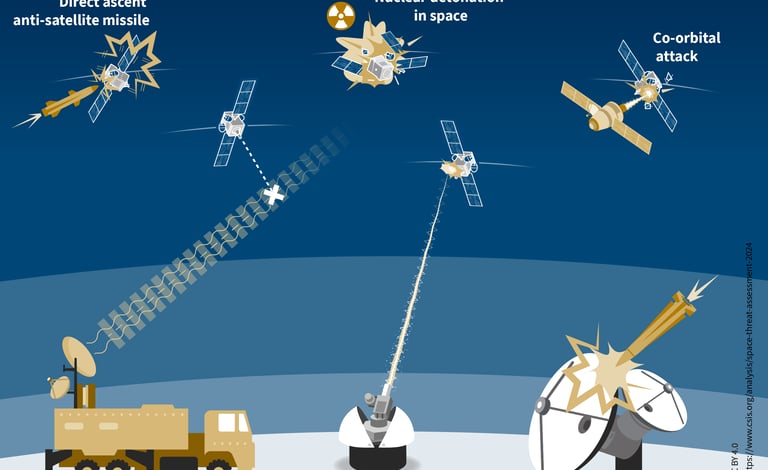
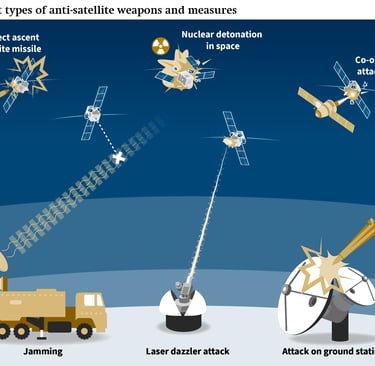
The prospect of a nuclear detonation in orbit is often misunderstood. Such a scenario would not resemble the destruction associated with a nuclear strike on a city. The immediate casualties might be limited. The strategic consequences, however, could be extraordinary. A high-altitude detonation could generate electromagnetic effects capable of damaging large numbers of satellites. It could create vast clouds of debris and radiation that persist for years or even decades. Certain orbital corridors could become hazardous or unusable. Communications, navigation and surveillance systems upon which entire societies depend could be degraded simultaneously.
What makes this possibility particularly unsettling is that it targets the hidden architecture of modern civilization. Most people rarely think about satellites, yet they underpin almost every aspect of contemporary life. Financial transactions rely on precise timing signals. Air traffic management depends on satellite navigation. Emergency services, logistics networks, military operations and telecommunications all rely on assets orbiting above the planet. In this sense, the vulnerability of space infrastructure reveals a paradox of modern technological progress: the more interconnected societies become, the more dependent they become on systems that few citizens ever see.
Germany's response illustrates a broader shift occurring across Europe. For decades, European security discussions focused primarily on land forces, maritime capabilities and conventional deterrence. Russia's invasion of Ukraine altered that calculus. It reminded policymakers that strategic vulnerabilities often emerge in areas long neglected by peacetime planning. Space now joins cybersecurity, critical infrastructure and artificial intelligence as domains increasingly viewed through a security lens.
The significance of Traut's remarks lies not only in the threat he describes but also in the capabilities Germany is preparing to acquire. Jammers, lasers, inspection satellites and sovereign military communications networks represent elements of a doctrine that would have seemed politically difficult to discuss openly in Germany only a decade ago. Berlin's message is clear: resilience requires not only protection but also deterrence. The traditional distinction between civilian and military space activities is becoming increasingly blurred.
This transformation reflects a wider geopolitical reality. The post-Cold War assumption that economic interdependence would gradually reduce strategic competition has largely disappeared. Relations between major powers are increasingly shaped by concerns over technological dominance, supply chains, critical infrastructure and strategic autonomy. Space sits at the intersection of all these issues. It is simultaneously a commercial marketplace, a scientific frontier and an arena of geopolitical rivalry.
The United States understood this trend earlier than most. The creation of the U.S. Space Force signaled Washington's belief that space would become an operational military domain alongside land, sea, air and cyberspace. China has invested heavily in anti-satellite capabilities, space launch systems and orbital infrastructure. Russia has long regarded space as a strategic arena tied to its broader military posture. Europe, by contrast, has often appeared reluctant to frame space in explicitly military terms. That reluctance is fading.
The emerging European debate is therefore about more than satellites. It is about sovereignty. The war in Ukraine exposed the extent to which European security depends on external capabilities. Commercial satellite networks, particularly those operated by private companies, played a significant role in maintaining Ukrainian communications. While effective in the short term, such dependence raises uncomfortable questions. Should European security rely on infrastructure controlled outside Europe? Can strategic autonomy exist without sovereign access to critical space systems? Germany's planned SATCOMBw 4 constellation reflects an attempt to answer those questions.
There is also a deeper historical dimension. Every major transformation in military affairs has been accompanied by a struggle to establish rules and norms. The twentieth century produced treaties governing nuclear weapons, chemical weapons and outer space itself. Yet many of those frameworks were designed for an earlier technological era. They did not anticipate a world in which thousands of satellites orbit the Earth, private companies operate strategic infrastructure and artificial intelligence increasingly integrates with military systems. The legal architecture of space governance is struggling to keep pace with technological reality.
The danger is not necessarily that a nuclear device will be detonated in orbit tomorrow. The danger is that the strategic logic driving states toward greater militarization of space continues to accelerate. As one country develops defensive capabilities, others perceive potential offensive advantages. As vulnerabilities become more visible, governments seek tools to mitigate them. The result is a familiar security dilemma: efforts to increase security can inadvertently increase competition.
For Europe, the challenge extends beyond military preparedness. It involves determining what role the continent intends to play in a rapidly changing international order. Can Europe remain primarily a regulatory power while others dominate strategic technologies? Can it protect its interests without developing capabilities that previous generations might have considered provocative? Can it preserve international norms while preparing for scenarios in which those norms are ignored?
These questions explain why Germany's warning deserves attention. It is not merely an assessment of Russian capabilities. It is evidence of a broader shift in strategic thinking. European policymakers increasingly view space not as a distant frontier but as an essential layer of national security.
The greatest irony may be that humanity's most advanced technological achievements have brought it back to one of the oldest realities of international politics: power, vulnerability and competition remain inseparable. The difference is that the next contest for strategic advantage may not be fought over territory on Earth. It may be fought in the silent expanse above it, where the infrastructure of modern civilization now resides.
The future of security will still be decided by human choices. But increasingly, those choices will extend far beyond the atmosphere.