THE LAND THAT REMEMBERS Inside the Hundred-Year Wound of Chameria
This is the story of how a strip of coastline became a permanent argument — and why, a hundred and thirteen years after six ambassadors in London drew a line through it, that argument still has the power to derail a country's path into the European Union.
THE LAND THAT REMEMBERS
Inside the Hundred-Year Wound of Chameria
A narrative investigation
There is a date carved into Albania's civic calendar that most of the world has never heard of: June 27. On that day each year, in a country still arguing with its own borders, schoolchildren in Tirana recite poems about a homeland they have never seen. Old men in Vlorë and Durrës — men who arrived as toddlers on the backs of fleeing parents eighty-odd years ago — light candles for villages that, in a strict legal sense, no longer belong to anyone they know.
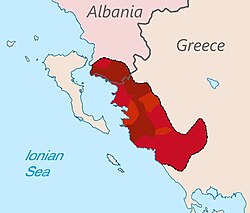
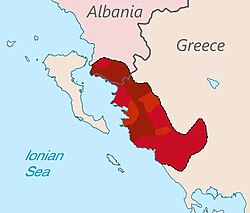
The villages are real. They sit today inside Greece, in a quiet administrative region called Thesprotia, a green wedge of olive groves and Ionian coastline that tourists pass through on the way to Parga and Corfu. Almost none of them know what the place used to be called.
The Albanians call it Chameria. And depending on who you ask — an Albanian nationalist politician, a Greek diplomat, a half-forgotten German Wehrmacht sergeant's postwar testimony, or a Columbia University historian trying gently to referee the whole argument — Chameria is either the site of an unpunished genocide, or the site of a population's just comeuppance for collaborating with the men who murdered their neighbors. Both stories are documented. Neither side believes the other's documents.
This is the story of how a strip of coastline became a permanent argument — and why, a hundred and thirteen years after six ambassadors in London drew a line through it, that argument still has the power to derail a country's path into the European Union.
Picture London in the winter of 1912. The Ottoman Empire is collapsing in the Balkans like wet paper. Six ambassadors — British, French, German, Austro-Hungarian, Russian, Italian — are sitting in St James's Palace under the chairmanship of Sir Edward Grey, trying to decide what to do with the wreckage. One of the smaller items on their docket is a strange new country nobody quite expected: Albania.
The Albanians wanted independence, and on paper, on 29 July 1913, they got it. But independence came with an asterisk the size of a province. Pressured by Greece and Serbia — the war's victors, flush with momentum — the ambassadors carved away roughly half the territory the Albanian national movement considered its own. Kosovo went to Serbia. The southern coastal strip — Chameria — went to Greece.
A boundary commission was dispatched to make the new line official. It tried, briefly, to draw the border along ethnic lines. It failed — the population was too mixed, too tangled by centuries of migration and conversion — and fell back instead on something colder: strategy, economics, geography. Italy didn't want a Greek navy staring across the strait at Corfu. Austria-Hungary didn't want Greece any bigger than it had to be. Somewhere in the horse-trading between empires that didn't live there, a place called Chameria stopped being discussed as a homeland and started being discussed as a hinge point on a map.
Even before the ink dried, the line was already producing bodies. In January 1913 — months before the formal decision — Greek irregulars executed between 72 and 78 Muslim Cham notables from the town of Paramythia. Greece has officially denied it ever happened. Albanian historians cite it as exhibit one. Both things are true simultaneously, which is, as it turns out, the central feature of this entire story: there are very few facts here that both sides agree to call facts.
By December 1913, the Protocol of Florence had made it official. Eight hundred thousand people were inside the new Albania. Seven hundred thousand ethnic Albanians were not — scattered now across Serbian and Greek territory, citizens of countries that, in the Albanian telling, had simply won a war and taken the spoils.
For two decades, the wound scarred over, badly. Then fascism found it and reopened it on purpose.
In the 1930s, Mussolini's Italy began courting the Chams the way occupying powers always court a grievance: with a promise. Help us, and Chameria will be yours again. Italian intelligence ran agents and saboteurs across the border. Galeazzo Ciano, Mussolini's foreign minister, personally ordered operations designed to destabilize the region in the run-up to Italy's invasion of Greece. When the invasion came in October 1940, some 3,500 Albanians — many of them Chams — marched alongside the Italian army.
They were, by most accounts, terrible soldiers. Poorly motivated, badly led, many deserted within days. But what some of them did off the battlefield is what Greek history remembers: looting, burning, the torching of Igoumenitsa, the murder of local notables in Paramythia and Filiates. A cycle of revenge — communal, intimate, soaked in old grudges over land and religion — was now being fed gasoline by a world war. What happened over the next four years reads, from a distance, like two separate atrocities running on parallel tracks that occasionally collided.
Track one: In September 1943, members of Nazi Germany's 1st Mountain Division — alongside Cham Albanian militia who had thrown in with the occupiers — rounded up the leading citizens of Paramythia: a priest, a doctor, five teachers, the town's most prominent businessmen. Over ten days they executed 201 of them and burned nineteen surrounding villages to ash. A German firing-squad sergeant later testified that Cham militiamen stood in the line with rifles. At Nuremberg in 1948, American judges had a one-word verdict for what happened in Paramythia: murder.
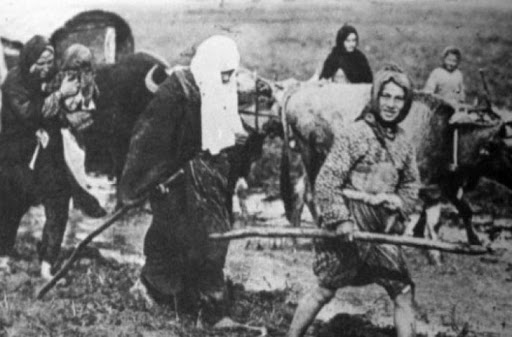
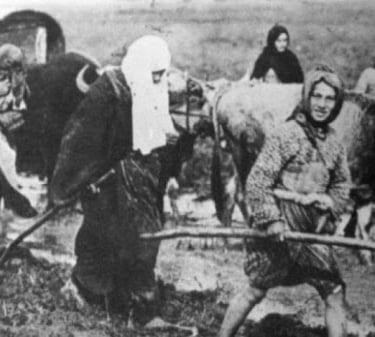
Track two: As the Germans pulled out of Greece in the summer of 1944, the right-wing resistance group EDES — backed by British supply lines — turned its attention to the Muslim Cham population it held responsible for track one. What followed was not a battle. It was a clearance. Village by village, Thesprotia's Muslim Albanian population was pushed north into Albania, sometimes at gunpoint, sometimes simply by the certainty of what would happen if they stayed. At Paramithia in late June 1944, EDES fighters killed 328 people — women and children among them. A final massacre at Filiates in March 1945, carried out by EDES veterans and armed civilians, closed out what historians now call, carefully, the expulsion. Albanians call it something else. They call it genocide.
Here is the uncomfortable center of the story: nobody — not one institution, not one tribunal, not one government — has ever produced a casualty count that both Tirana and Athens accept.
The most-cited academic figure, from historian Paul Mojzes's survey of Balkan genocides, puts Greek nationalist forces' death toll at a minimum of 2,877 Albanian Chams, with 475 women raped and more than 68 villages destroyed — and roughly 20,000 people ethnically cleansed in total. Albanian Cham advocacy groups push the number higher: at least 5,800 dead. No Greek academic source in the historical record matches either figure. Greek accounts, instead, lead with what came before: the 201 dead of Paramythia, the more than 300 Christian civilians killed by Cham militia earlier in the war, the description — offered flatly by German historian Norbert Frei — of the Muslim Cham minority as Greece's "fourth occupation force."
Between 14,000 and 35,000 people were displaced, depending on which historian you read. Even the foundational number of the tragedy — how many people did this happen to — refuses to sit still.
And in the most quietly damning detail of the entire affair: nobody was ever actually punished for any of it. A Greek special court in Ioannina convicted 2,109 Cham collaborators to death — in absentia, because every one of them had already fled the country. The sentences were symbolic from the moment they were handed down. Meanwhile, not a single EDES fighter responsible for the reprisal massacres at Filiates or Paramithia ever stood trial for those killings. Two communities, two atrocities, zero convictions that meant anything. A war crime with collaborators who can't be found and perpetrators who were never sought — that is not a closed case. That is simply a case nobody filed.
The violence ended in 1945. The dispossession kept going for another fourteen years, conducted not by militias but by Greek parliamentary committee.
In 1953, a law declared "abandoned" any rural property whose owner had left the country without official permission — a description that fit, conveniently, almost every fleeing Cham family. Three years later, those properties were nationalized outright. In 1959, a second law extended the same logic to homes. Other families — many of them Aromanian — moved into the empty houses, though even they never received clean legal title; ownership stayed with the Greek state.
It was bureaucratically tidy. It was also, depending entirely on which side of the border you were born, either standard postwar collaborator law or the second half of an ethnic cleansing — finished not with rifles but with paperwork. European courts, asked decades later to revisit the confiscations, sided with Greece: collaborators lose their property, the case law says, and Cham descendants' appeals — including to European courts — have failed every time.
For nearly half a century, Chameria lived mostly as private grief — a story told at kitchen tables in refugee neighborhoods around Vlorë and Tirana, kept alive by the generation that remembered and quietly buried under four decades of Albanian communism, which had little patience for any nationalism that wasn't its own.
Then, in January 1991, as Albania's communist state was dying in real time, the Chameria National Political Association was founded — the first organized political voice the Cham diaspora had ever had. Two decades later, it became an actual party: the Party for Justice, Integration and Unity, founded in March 2011, which won parliamentary seats and filed a formal demand that has never been quietly forgotten — $10.7 billion in reparations from the Greek government. Its leader, Shpëtim Idrizi, has a line he returns to at every June 27 commemoration: "Chameria is an open wound for the nation."
By 2016 the wound had reached Brussels. The EU's own Enlargement Commissioner, Johannes Hahn, called the Cham issue an "existing" unresolved matter between the two countries. Greece's foreign minister, Nikos Kotzias, demanded a retraction in some of the sharpest diplomatic language an EU official has aimed at another EU official in recent memory. Albanian MPs, naturally, applauded Hahn instead.
Six years later, the fight reached the European Parliament floor directly. Greek MEPs filed a written complaint over an Albanian parliamentary ceremony marking "78 years since the genocide" — children reciting what the complaint called irredentist poems — and asked the European Commission, pointedly, what it made of "such irredentist manifestations on the part of a candidate for EU accession against a Member State." It was no longer a historical argument. It was now, explicitly, a lever in Albania's EU membership bid.
Even Prime Minister Edi Rama has picked up the language, telling an audience on Greek soil that Albanians remember "the violent displacement of our ancestors from their homes in the north of Greece." Greece's embassy in Tirana has, in turn, condemned the commemorations as built on what it calls an "alleged genocide" — two governments, mid-EU-accession-process, still arguing in public about whether a word applies.
THE COMMISSION THAT NEVER MET
There was, at one point, an attempt at adult supervision. In 1999, Albania and Greece agreed to form a bilateral commission to handle — narrowly, technically — the property question. No genocide debate, no reparations demand. Just: whose house was it.
A quarter of a century later, that commission has never once convened.
Historians who tried to do what their governments wouldn't found the same wall. At a rare joint dialogue convened by Columbia University, Greek and Albanian scholars sat in the same room and arrived at a shared, almost weary conclusion: discussing the Cham issue remains, in their words, "very sensitive in Greece," propaganda runs thick on both sides, and the prevailing official Greek posture toward the entire subject can be summarized in four words — "The case is closed." Tirana disagrees. Tirana has disagreed, loudly, every June 27 since 1994, when its parliament made the disagreement an official holiday.
In Konispol, the southernmost sliver of Albania still touching the old Chameria coastline, a 27-year-old named Sildi Koqini has made the memory her life's work. Her grandfather was two years old when his family fled north in 1944. She never met the village he came from in any way that counted — she only inherited the longing for it.
"History must be passed down from generation to generation," she says. "In this way, my grandfather also lives."
It is the kind of sentence that makes for moving journalism and terrible diplomacy — because it is also, word for word, the exact mechanism by which a hundred-year-old border dispute outlives every person who could remember the actual border being drawn. Nobody alive today negotiated the Protocol of Florence. Almost nobody alive today personally pulled a trigger in Paramythia or Filiates. And yet the argument has never needed eyewitnesses to survive. It only needs grandchildren willing to light the candle.
A fair investigation does not get to invent the consensus that two governments, eighty years of competing historiography, and one inert EU commission have all failed to produce. So this report will not tell you Chameria was a genocide, and it will not tell you it wasn't. What it can tell you, with confidence, is this:
No international tribunal has ever applied the word "genocide" to these events — Albania's use of the term rests on a 1994 domestic parliamentary declaration, not an external legal finding. The Cham collaboration with Axis forces, including direct participation in the murder of Greek civilians at Paramythia, is documented across Albanian, Greek, German, and Anglo-American sources and is not seriously in dispute. The expulsion that followed killed a contested but substantial number of civilians — likely in the low thousands — through a campaign that was retaliatory, extra-legal, and conducted with Allied logistical knowledge if not Allied design. Property was confiscated through laws later upheld by courts that never had to weigh the moral case, only the technical one. And the one mechanism either government ever built to resolve any of it — a four-paragraph bilateral commission agreed in 1999 — has sat, unconvened, for longer than the war itself lasted.
That is not a closed case. It is a case both governments have found more useful left open.
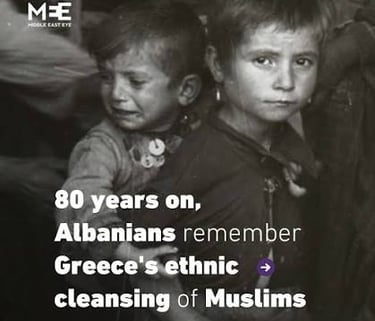
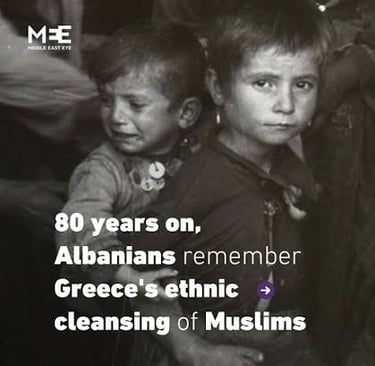
This investigation draws on sourced historical entries on the London Conference of 1912–13, the Treaty of London, the Expulsion of Cham Albanians, Cham Albanian collaboration with the Axis, the Paramythia executions, and the Cham issue; Middle East Eye's 80th-anniversary reporting; the European Parliament's 2022 written question E-002302/2022; Columbia University's Historical Dialogue on Cham Issues; Robert Elsie, Bejtullah Destani and Rudina Jasini's documentary history of the Cham Albanians; and Albanian-language commemorative coverage