The Founder We Remember and the Leadership We Forgot
Evarist Beqiri's new book on Ismail Qemali raises a larger question: why does modern Albania continue to celebrate its founder while struggling to preserve the leadership principles that made independence possible?
The Founder We Remember and the Leadership We Forgot
Evarist Beqiri's new book on Ismail Qemali raises a larger question: why does modern Albania continue to celebrate its founder while struggling to preserve the leadership principles that made independence possible?
Every Albanian knows the image. An elderly statesman with a white beard stands in Vlora on 28 November 1912 and proclaims the independence of Albania. Schoolchildren learn the date. Politicians quote his words. His portrait hangs in public institutions. Streets, schools and squares bear his name. More than a century after his death, Ismail Qemali remains one of the few figures capable of commanding almost universal respect across Albania's political divides. Yet there is a paradox at the heart of Albanian public life. The more we celebrate Ismail Qemali, the less we seem to discuss the qualities that made him indispensable to the creation of the Albanian state.
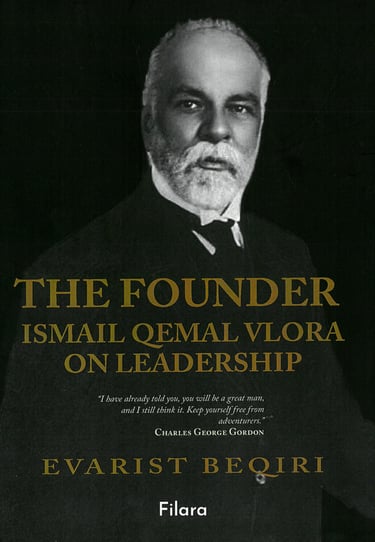
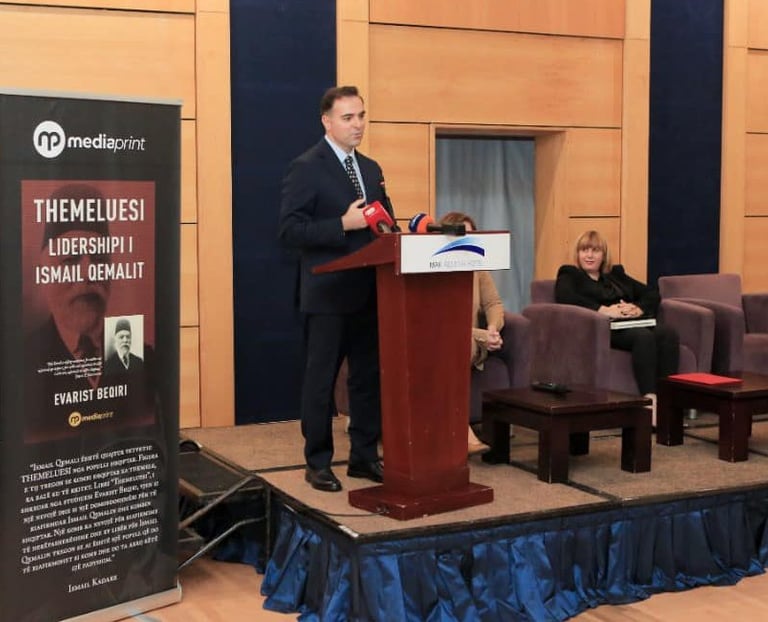
This is what makes Evarist Beqiri's newly published English-language edition of The Founder – Ismail Qemal Vlora on Leadership particularly interesting. The book is not merely another biography of the man who declared Albanian independence. Nor is it simply a translation of an earlier Albanian work. Beqiri has expanded, revised and substantially rewritten the text, incorporating new documents, interviews and historical material. More importantly, he approaches Ismail Qemali through a lens that is often missing from Albanian historical writing: leadership. The distinction matters. History books frequently tell us what happened. Far fewer attempt to explain why certain individuals succeed where others fail. Why was Ismail Qemali able to unite rival regional interests? Why did people trust him? Why was he capable of transforming an aspiration shared by many into a political reality achieved by few? These questions are not only historical. They are contemporary. In his interviews promoting the book, Beqiri repeatedly returns to Ismail Qemali's belief that lasting peace in the Balkans could not exist without a just solution to the Albanian question. Whether one agrees with every aspect of that assessment is ultimately less important than recognising the broader characteristic it reveals: Ismail Qemali was thinking strategically about the future of the region rather than merely reacting to the crises of the moment. That quality is surprisingly rare in politics. The challenge facing modern democracies is often not a shortage of politicians but a shortage of leaders capable of looking beyond electoral cycles and immediate controversies. Leadership requires the ability to connect present decisions with future consequences. It requires patience, vision and the willingness to place long-term national interests above short-term political gains. It is precisely this dimension that Beqiri seeks to recover. Modern discussions of leadership frequently focus on charisma. Historical experience suggests something different. The leaders who leave lasting legacies are often not the loudest voices in the room. They are those capable of building consensus, navigating competing interests and creating institutions that outlive them. This was the environment in which Ismail Qemali operated. The Albania of 1912 was not a consolidated nation-state. It lacked many of the institutions that modern societies take for granted. Regional loyalties were strong. External pressures were immense. Great powers were redrawing the political map of the Balkans. The collapse of the Ottoman Empire created both opportunities and dangers. Under such circumstances, independence was far from inevitable. What distinguished Ismail Qemali was not merely his patriotism. Many Albanians were patriots. It was his ability to transform patriotism into diplomacy, diplomacy into strategy and strategy into statehood. That lesson remains relevant today. Across Europe and beyond, democratic societies are grappling with questions of political trust. Citizens increasingly express frustration with institutions and public officials. Political discourse often rewards confrontation more than cooperation. Public debate moves faster than reflection. In such an environment, historical figures can serve an important purpose—not because they provide ready-made solutions but because they remind us of qualities that remain essential for effective leadership.
This is where Beqiri's book transcends the boundaries of traditional historical scholarship. The book invites readers to consider whether Albania has fully absorbed the lessons of its own founding generation. We remember the achievements of Ismail Qemali. We celebrate the declaration of independence. We honour the symbolism. Yet symbols alone do not sustain nations. Nations are sustained by values, institutions and leadership cultures that pass from one generation to the next. The uncomfortable question is whether Albania has preserved that inheritance as effectively as it has preserved the memory of the man himself. This is not merely an Albanian question. It is a European one. Many nations commemorate their founders while gradually losing contact with the principles that guided them. Historical memory becomes ceremonial rather than instructive. Leaders become monuments rather than teachers. Their names survive while their lessons fade. Perhaps this is why Ismail Qemali continues to attract the attention of historians, researchers and writers more than one hundred years after the raising of the flag in Vlora. He represents more than a historical achievement. He represents a model of leadership forged during one of the most difficult periods in Albanian history.
Evarist Beqiri's contribution is therefore not simply the publication of a new book. It is the reopening of a conversation that Albania should never have abandoned. A conversation about what leadership means, how nations are built and whether the qualities that created Albania in 1912 still have something to teach Albania in 2026. The answer may determine whether Ismail Qemali remains merely a revered figure of the past or continues to serve as a guide for the future.