The EU–Korea summit Beyond Trade
Why Brussels Is Deepening Its Strategic Partnership with South Korea
Beyond Trade: Why Brussels Is Deepening Its Strategic Partnership with South Korea
The EU–Korea summit reveals how Europe is expanding its network of security, technology and economic alliances in response to a rapidly changing geopolitical landscape.
By Spartak Fikaj
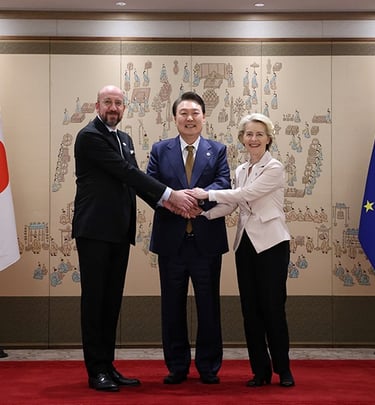
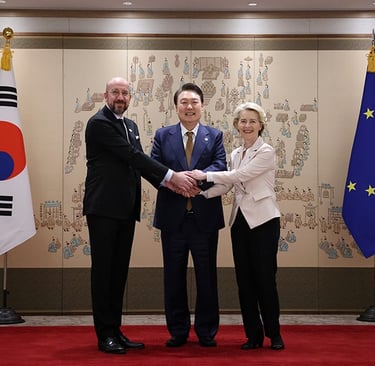
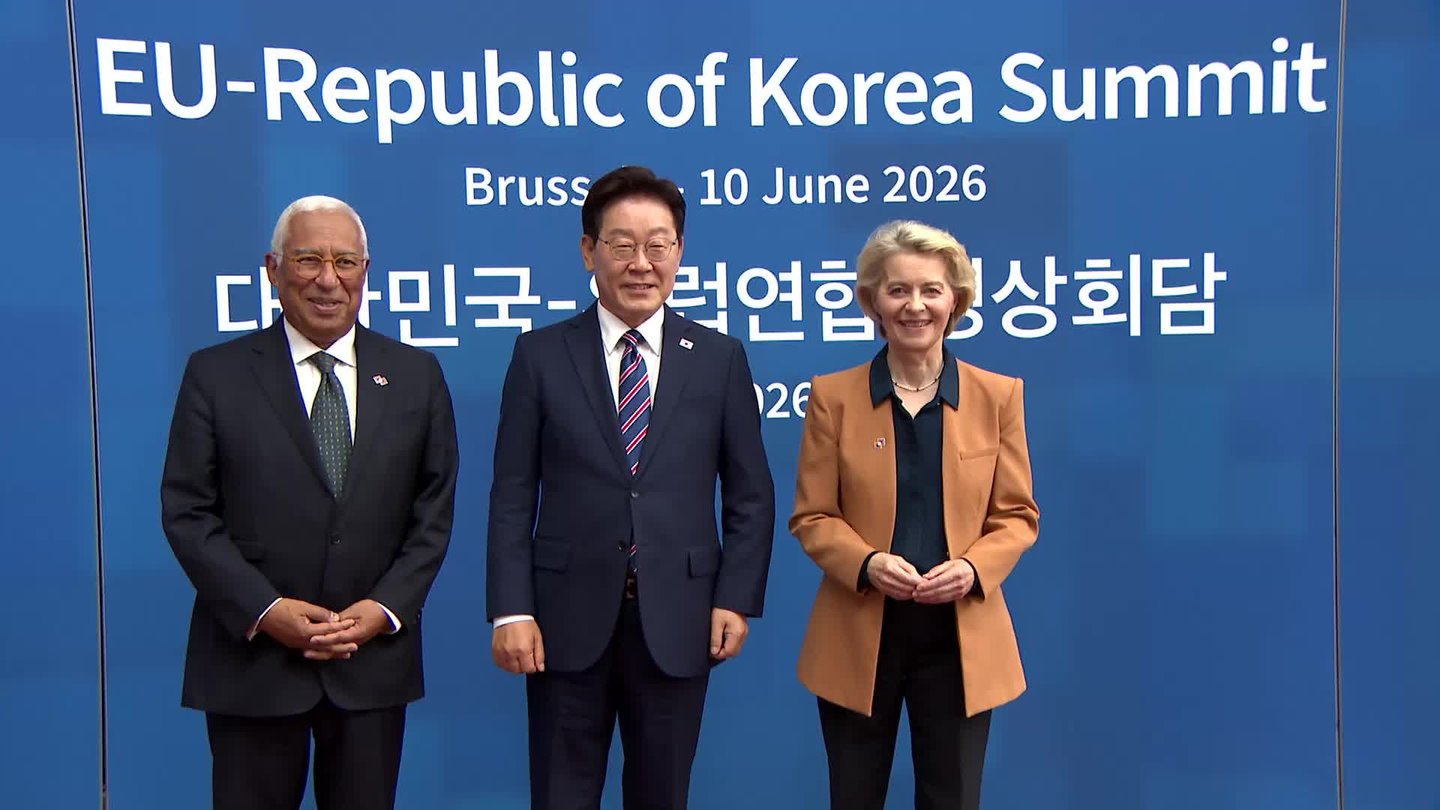
BRUSSELS — Official summit statements are often written in the cautious language of diplomacy, designed as much to avoid controversy as to announce policy. Yet behind the carefully balanced words chosen by European Council President António Costa following the eleventh summit between the European Union and the Republic of Korea lies a significant story about the direction of European foreign policy and the changing architecture of international partnerships in the twenty-first century.
At first glance, the summit appeared to focus on familiar themes. Leaders celebrated the success of the EU–Korea Free Trade Agreement, highlighted expanding cooperation in education and innovation, and announced a series of new initiatives ranging from digital trade to economic competitiveness. However, when examined in the context of broader developments over the past several years—including Russia's invasion of Ukraine, growing concerns over economic security, increasing technological competition, tensions in the Indo-Pacific, and uncertainty regarding the future of the international order—the summit takes on a far greater significance.
What emerged from Brussels was not merely an economic partnership but evidence of a broader strategic convergence between two democratic powers that increasingly find themselves confronting similar challenges. While separated geographically by thousands of kilometres, the European Union and South Korea now share concerns about supply chain vulnerabilities, technological dependence, regional security threats, the resilience of democratic institutions, and the preservation of an international system based on rules rather than power alone.
The most concrete achievement of the summit was the signing of a new Digital Trade Agreement, described by Costa as a landmark achievement. In practical terms, the agreement seeks to establish common standards for digital commerce, facilitate cross-border data flows, promote innovation and provide businesses with greater legal certainty in an increasingly digital global economy. Yet its significance extends beyond economics. Over the last decade, digital infrastructure, artificial intelligence, semiconductors and advanced communications technologies have become strategic assets. Governments no longer view these sectors merely as sources of economic growth but as components of national security. By establishing deeper digital integration with South Korea, one of the world's leading technology powers, the European Union is strengthening both its economic competitiveness and its strategic resilience.
This concern with resilience appears throughout Costa's remarks. The language of economic security, supply chain reliability and industrial cooperation reflects a broader transformation in European thinking that has accelerated since the COVID-19 pandemic and Russia's full-scale invasion of Ukraine. European policymakers increasingly argue that economic openness must be balanced by a capacity to withstand external shocks and geopolitical pressure. In this context, South Korea occupies a particularly valuable position. It is a leading producer of semiconductors, batteries, advanced electronics and digital technologies—precisely the sectors that Brussels regards as critical to Europe's future competitiveness.
Perhaps even more revealing than the Digital Trade Agreement was the decision to begin negotiations on a Security of Information Agreement. Such agreements rarely attract public attention, yet they are often essential foundations for deeper security cooperation. The announcement suggests that both parties anticipate greater collaboration in areas where information sharing, trust and institutional coordination are indispensable. Although neither side framed the initiative as a response to any specific country, it is difficult to separate it from the broader security environment that has emerged in recent years. Russia's war against Ukraine, North Korea's military cooperation with Moscow, growing tensions in East Asia and concerns regarding hybrid threats have encouraged democratic partners across different regions to coordinate more closely than at any point since the end of the Cold War.
The summit also demonstrated how the European Union's foreign policy is gradually extending beyond its traditional neighbourhood. For decades, European diplomacy concentrated heavily on the Mediterranean, Eastern Europe, Africa and the Middle East. Today, however, Brussels increasingly views developments in the Indo-Pacific as directly relevant to European prosperity and security. The reasoning is straightforward. Much of the world's trade passes through Indo-Pacific sea lanes. Critical supply chains originate there. Technological innovation is increasingly concentrated there. Any disruption in the region would inevitably affect European economies. As a result, partnerships with countries such as South Korea, Japan, Australia and India have become central pillars of the EU's broader strategic outlook.
Interestingly, one of the most important actors influencing the summit was never mentioned by name. China appears nowhere in Costa's statement. Yet many of the initiatives announced in Brussels can only be fully understood against the backdrop of Europe's evolving relationship with Beijing. The emphasis on competitiveness, industrial policy, economic security and critical technologies reflects concerns shared by many European governments regarding strategic dependencies and technological vulnerabilities. South Korea faces many of the same dilemmas. Both Brussels and Seoul seek to maintain constructive economic relations with China while simultaneously reducing exposure in sectors considered vital to national interests. This shared balancing act has created new incentives for cooperation.
The discussion on Ukraine further illustrated the growing alignment between Europe and South Korea. Costa's remarks left little doubt regarding the European Union's position. By praising Korean support for Ukraine and warning against the consequences of unchecked military aggression, he linked the conflict directly to the future of the international order. His argument was not merely about Ukraine itself. It was about the principle that national borders cannot be changed by force and that sovereignty remains a cornerstone of international stability. For European leaders, the defence of Ukraine has become inseparable from the defence of the broader rules-based system upon which many middle powers, including South Korea, depend.
Viewed in isolation, the agreements announced during the summit may appear incremental. Viewed together, they reveal something more substantial. The European Union and South Korea are steadily constructing a multidimensional partnership encompassing trade, technology, economic security, defence cooperation, diplomatic coordination and people-to-people exchanges. This process is unlikely to generate dramatic headlines in the manner of military alliances or geopolitical confrontations. Yet its long-term significance may prove considerable. In an era increasingly characterised by fragmentation, strategic competition and geopolitical uncertainty, both Brussels and Seoul appear to have concluded that their security and prosperity are best protected through deeper cooperation with trusted democratic partners.
For the European Union, the summit serves as another indication that its foreign policy is evolving. Europe is no longer focusing exclusively on its immediate neighbourhood but is increasingly building relationships across the Indo-Pacific with countries that share similar values, economic interests and strategic concerns. For South Korea, the summit confirms its growing importance as a global actor whose influence extends well beyond Northeast Asia. The Brussels meeting may therefore be remembered not simply as another diplomatic gathering but as a milestone in the gradual emergence of a broader partnership linking Europe and the Indo-Pacific in response to the challenges of a changing world order.