THE COAST THEY DREW BEFORE WE SAW IT
Two secret resort masterplans, a network of dormant companies, and a contradiction Balfin has not explained
THE COAST THEY DREW BEFORE WE SAW IT
Two secret resort masterplans, a network of dormant companies, and a contradiction Balfin has not explained
The wind reaches the Vjosa Delta before anything else does. It bends the reeds, moves across the sandbars, and carries the smell of brine and wet earth out toward the Adriatic. Flamingos stand motionless in the shallows. The river, after running unbroken from the mountains of Greece, finally surrenders here — not in a dramatic plunge but in a slow argument between fresh water, salt water, and sand that has been going on for centuries and shows no sign of ending.
Conservationists call this delta one of the last intact wild coastlines in the Mediterranean. Albania's tourism planners call the same stretch of coast something else: the country's most valuable piece of undeveloped land. Both descriptions are accurate. That is the entire problem.
This spring the tension stopped being theoretical. Thousands of Albanians marched through Tirana carrying inflatable flamingos and signs reading "Albania is not for sale," protesting a $1.6 billion resort linked to Jared Kushner's investment firm, Affinity Partners, planned for the island of Sazan and the Narta lagoon near Zvërnec. Police met them with water cannon. Anti-corruption prosecutors opened an investigation into how the underlying land titles were acquired and later froze a developer's bank accounts. A Greek citizen was injured in a clash with private security at the fenced-off site, drawing a formal protest from Athens. Prime Minister Edi Rama, defending the deal on American television, told critics it was "not your fight."
That was the project everyone in Albania was watching. According to documents obtained by the investigative outlet Citizens.al, it was not the only one being drawn for this stretch of coast — and one of the others is not actually secret at all. It is sitting, in detailed investment language, on the developer's own website.
Two plans nobody was meant to see — except one of them, in public, all along
In mid-December 2024, Citizens reports, two architectural masterplans were quietly completed for the Balfin Group, Albania's largest privately held conglomerate. Neither went to public comment. Neither appeared in a government announcement. Both surfaced in investigative reporting only because journalists obtained the files directly.
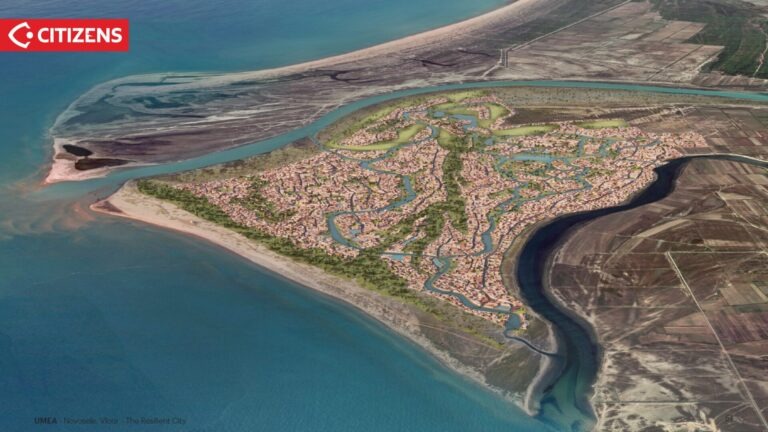
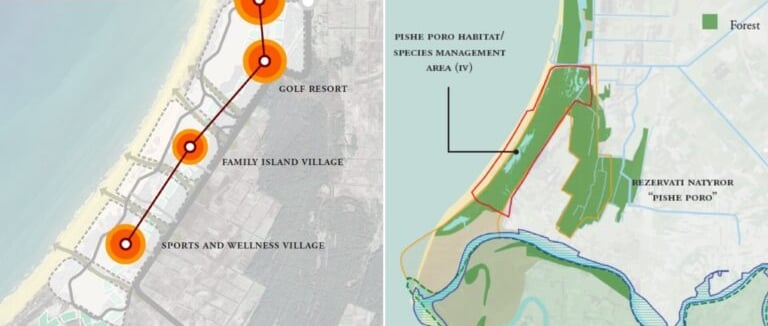
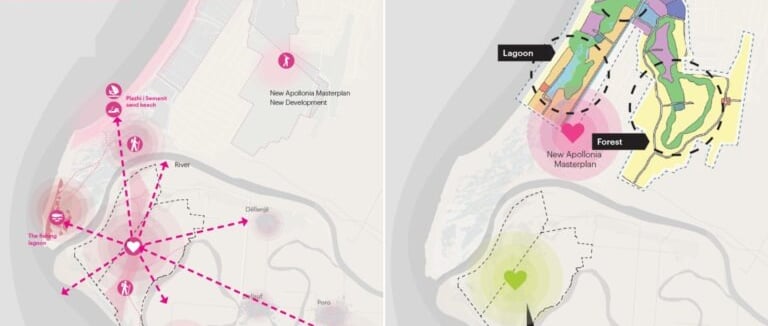
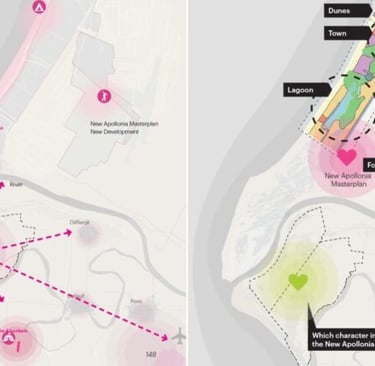
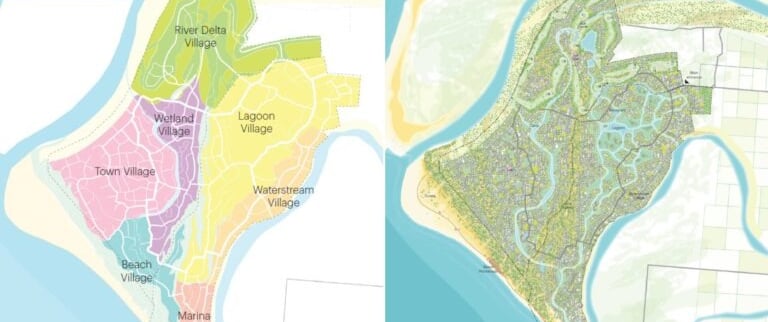
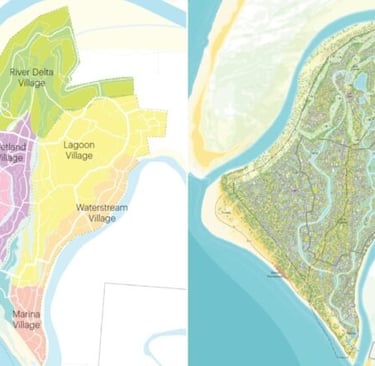
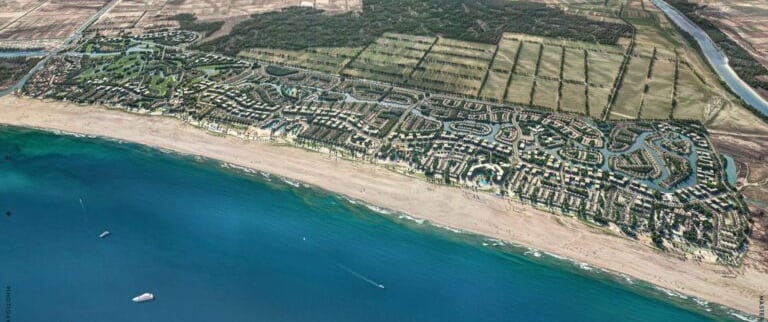
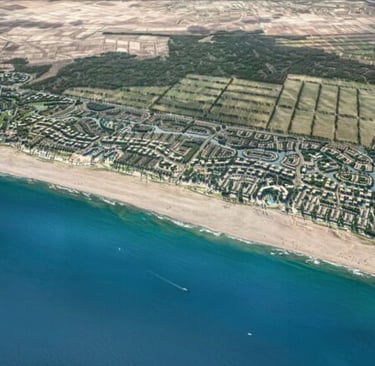
The first, UMEA, was designed by the Dutch firm MVRDV for roughly 639 hectares on the southern edge of the Vjosa Delta near Novoselë. The second, New Apollonia, was completed three days earlier by the American firm WATG with the golf specialists Lobb + Partners, for roughly 600 hectares between Darëzezë and the Seman beach, just north of the delta. Together the two concepts cover close to 1,250 hectares — larger than many Albanian towns — wrapped around one of the most ecologically sensitive river mouths in southeastern Europe.
The language is careful: "untouched nature," "ecological corridors," "invisible architecture." The arithmetic is not. New Apollonia alone is built around 1.52 million square meters of construction, more than 9,000 residential units, nearly 3,000 hotel units, a marina district, a golf resort, an aquapark, and 8.5 kilometers of internal canals, for a projected population over 45,000. UMEA gives roughly two-thirds of its land to villas, apartments, golf, hotels and roads, leaving under a third as open space.
Asked about the documents, Balfin told Citizens the plans were unrealized concepts prepared for a real-estate fair in Munich, since abandoned: "We have participated with more than 10 concept-ideas, of which we have only moved forward with the projects in Austria, the United States and Portugal. No project was detailed, only a concept-idea."
That statement does not match what Balfin's own company website says about the same project.
On its real-estate division's page, under the heading "New Apollonia — A Coastal City Inspired by Ancient Heritage," Balfin describes a five-kilometer beachfront promenade anchoring "a master planned community of residences, seafront resorts, senior living communities, a golf course, marina, cultural venues, and retail streets." The page does not hedge or describe a shelved idea. It calls New Apollonia "more than a resort," envisioned as "a vibrant coastal city where international tourism, premium living, and leisure opportunities converge year-round," and pitches it directly to capital: "For global investors and operators, New Apollonia offers early access to an emerging Adriatic real estate market, with flexible entry models spanning residential, hospitality, senior housing, and cultural assets."
That is not the language a company uses to describe a sketch it walked away from after a trade fair. It is the language a company uses to sell something it intends to build. Separately, Balfin Real Estate has presented New Apollonia alongside its other coastal projects — Green Coast, Vlora Marina, and Valamar Tale — at industry events including a regional property forum, listing it as one of the portfolio examples reflecting "the latest developments in tourism" and "integrated communities" in the Albanian market.
Both things cannot be fully true at once. Balfin cannot simultaneously tell journalists the project was never developed beyond a presentation concept and tell investors, on its own marketing platform, that it offers "early access" to a live coastal city with a marina, golf course, and senior-living district. One of those two statements describes a company protecting itself from scrutiny. The other describes a company actively trying to attract capital. Citizens' reporting on the figures behind New Apollonia — reportedly including a roughly €2.64 billion investment value and some 6 million square meters of total land — could not be independently confirmed from the public version of Balfin's site reviewed for this article, and should be treated as reported, not verified, until Balfin or its consultants confirm the numbers directly. But the existence of the marketing page itself, with its specific district-by-district description, is independently verifiable today, and it directly undercuts the company's own account of the project's status.
Albania's corporate registry shows New Apollonia SHPK was founded in July 2024 and UMEA SHPK in October 2024 — months before either masterplan was finished. Both are wholly owned through Balfin, with Samir Mane listed as ultimate beneficial owner. Their stated business purpose reads like a checklist lifted from the renderings themselves: construction and sale of residential units, tourism operations, management of accommodation, "use of coastal areas for tourism purposes."
Around those two parents, at least thirteen further entities appeared, named directly after pieces of the architecture: Apolonia Lagoon Development, Apolonia Golf Estates, Apolonia Wetlands Estates, Marina Gateway Development, Dunescape Apolonia, UMEA Seaside Hotel 2, Saphire Seas Development. Most were suspended in spring 2025 and again this past April. One, Apolonia Seafront Properties, was founded with New Apollonia as shareholder before its shares moved — for 4,500 lekë, about €43, plus an obligation to repay a 70,000-lekë loan — to a company called Blessed Investment, beneficially owned by businessman Besnik Leskaj.
None of that proves anyone intended to break ground. Shell companies are created and shelved constantly in speculative property; a low-value internal transfer is routine bookkeeping, not evidence of a crime. But a company named "Wetlands Estates," registered around a plan that maps the wetlands themselves as future lots, sits awkwardly next to Balfin's claim that the whole concept never left the drawing board. Someone built the legal scaffolding for construction whether or not construction was ever meant to follow — and someone, separately, kept the project live and pitched to investors on a public website years after telling reporters it had been shelved.
Balfin, moreover, does not appear to have been alone. Citizens' documents divide New Apollonia into four blocks: Balfin holding the largest at 377 hectares and 62.9 percent of the planned built area, with three smaller blocks attributed to entities linked to the Leskaj family, businessman Gentjan Sulaj, and businessman Genc Kuçuku. UMEA splits between a Balfin-led cluster and a second cluster involving the AGNA Group, GR Albania, and businessman Arian Leskaj, with that second group concentrated on the golf component — roughly 72 hectares. If the documents are accurate, neither project was ever one company's vision. Both look like a coalition of landholders organized around the last large stretch of undeveloped coast in the country.
New Apollonia and UMEA did not appear out of nowhere in Balfin's portfolio. The company's own promotional material draws a direct line from an earlier project, in Hamallaj, to what it now wants to build at Tale and on the Vjosa coast.
Balfin's Vala Mar Residences, on the coast at Hamallaj, established the template: villas with pools, sea-view apartments, a yacht marina, a boutique hotel, and a beach club, marketed as "a new experience that allows you to enjoy freedom amidst nature." A follow-on project, Next to Vala Mar, expanded the same formula on adjacent land. In its own account of the company's growth, Balfin describes Hamallaj as having transformed surrounding property values and become the model that the company is now extending northward through Valamar Tale — a project that, unlike UMEA and New Apollonia, has already reached the agenda of Albania's National Council of Territory and Water.
The pattern is consistent across all four projects. A hotel anchors the public narrative. Residential units — villas, apartments, senior-living units — anchor the balance sheet. Marina infrastructure and golf courses signal exclusivity and justify premium pricing. Sustainability language softens the scale of what is actually being proposed. None of this is unique to Balfin; it is the standard playbook of contemporary Mediterranean resort development, visible in Spain's Costa del Sol, Portugal's Algarve, and stretches of Croatia and Montenegro that were rebuilt by the same formula decades ago, with thousands of residential units sold off long before a single hotel turned a profit.
What makes the Albanian case unusual is not the model. It is the location. Hamallaj and Tale are not legally protected wetlands. The southern bank of the Vjosa Delta and the beaches of Darëzezë and Seman are part of, or directly adjacent to, a landscape that Albania has spent years promoting internationally as a conservation triumph.
The document that came first
The plans land harder once you read what preceded them by three years: a Strategic Environmental Assessment, completed in September 2021, for what planners called the Vjosë-Nartë Area of National Importance.
The assessment did not hide the stakes. It described a delta, lagoon, salt marsh, and dune system vulnerable to erosion, salinization, and habitat fragmentation. But its annexes also listed who had asked for the review in the first place — landholders with development interests in more than 1,500 hectares of that same protected landscape. Credins Bank held 600 hectares. The Mabetex–YDA consortium, which that same year won the concession to build Vlora's new international airport, held 309. AGNA Group held 240. A small Balfin-linked company called Sere held 20.
The assessment did not recommend a ban. It modeled three scenarios — no intervention, intensive tourism, and a "conservative" middle path proposed by the private landholders themselves — and effectively endorsed the third. That is the same argument that resurfaces, almost verbatim, in the UMEA and New Apollonia language three years later, and in Balfin's own marketing copy today: not encroachment on nature, but its management.
Vjosa-Narta stopped being a purely domestic story some time ago. In 2023, Albania declared the Vjosa Europe's first Wild River National Park — celebrated internationally as a conservation landmark. The park's boundary, notably, stopped short of the delta and the coastal wetlands around it: the same ground where UMEA, New Apollonia, and the Kushner-linked Sazan and Zvërnec projects now sit.
The Bern Convention has pressed Albania over construction near Vlora's airport inside that same protected landscape. EuroNatur and the BirdLife-affiliated PPNEA say recent works there proceeded without transparent review or public consultation. PPNEA's executive director, Aleksandr Trajçe, told The Guardian that "from start to finish there has been a total lack of transparency" around the resort plans encroaching on the wetland. Riverwatch's Ulrich Eichelmann told Citizens the Kushner plans and the Balfin-linked masterplans are two faces of the same model: "Greenwashing — the zone is presented as in harmony with nature, but in reality it is something else entirely. I think Kushner is only the beginning of this." Olsi Nika, head of EcoAlbania and a figure regularly cited by international conservation groups including EuroNatur on threats to the Vjosa system, frames the broader pattern as policy rather than coincidence: Albania protects only about a fifth of its territory by law, leaving room, in his view, to build resorts without ever touching the country's most ecologically valuable ground — yet developers keep returning to exactly that ground anyway.
For a country negotiating EU accession, this is not a footnote. The bloc's environmental rulebook — impact assessment, strategic environmental review, public consultation, habitat protection under the Bern Convention and the Birds Directive — exists specifically to stop governments from making irreversible decisions in sensitive landscapes without scrutiny. Brussels has already flagged Albania's uneven enforcement of those rules. A developer marketing a coastal city, marina, and golf resort to international investors on land overlapping one of the country's most internationally celebrated protected landscapes — while telling journalists the same project was never more than a concept — is not the kind of evidence that strengthens Tirana's case in Brussels.
Strip away the speculation and the confirmed facts are narrower than the rumor mill, but they are no longer only secondhand. New Apollonia and UMEA exist as registered companies, wholly owned through Balfin, with Samir Mane as beneficial owner. A network of related entities, named directly after the architecture, was built around them and then largely suspended. Detailed, large-scale masterplans for the territory were commissioned from internationally recognized firms. The Vjosa-Narta region is, beyond any real dispute, one of the most ecologically significant coastal landscapes left in Europe. And Balfin's own public-facing marketing material describes New Apollonia today, in the present tense, as an active, multi-district coastal city open to international investors — a description that sits uneasily beside the company's account, given to journalists, that the project never advanced past a concept stage.
What is still not established is whether either project ever sought, let alone received, formal government approval. No public record shows a construction permit, an environmental impact assessment specific to either plan, or a strategic-investment designation for UMEA or New Apollonia. The precise investment figures attributed to the project — a multibillion-euro valuation, a specific land-area total in the millions of square meters — appear in secondary reporting but could not be independently confirmed against Balfin's own published material for this article, and should be treated with appropriate caution until Balfin, MVRDV, or WATG confirm them on the record.
What has changed is the shape of the central question. It is no longer only "why was this corporate architecture built around a concept the company says it abandoned." It is now also: why does the company's own current marketing continue to describe that concept as a live investment opportunity, on its own website, with no disclaimer that the project was discontinued? Until Balfin reconciles those two accounts — one for the public record with journalists, one for the audience of international capital — both versions remain on the table, and only one of them can be true.
The river will keep moving toward the sea regardless of which version that turns out to be. Whether the public gets to see that decision made, and explained, before it becomes irreversible is, for now, the only question that matters.
This article is based on documents and corporate-registry findings published by Citizens.al, the current public content of Balfin's real-estate division website (balfin.al and balfinrealestate.com, reviewed June 2026), and reporting from Reuters, The Guardian, Al Jazeera, Time, OCCRP, the Times of Israel and Democracy Now! on the related Sazan/Zvërnec project. Balfin's statement to Citizens is quoted as published by that outlet. Specific investment-value and total-land-area figures attributed to New Apollonia beyond what is described in Balfin's own published marketing language have not been independently verified for this article and are flagged accordingly. Balfin, MVRDV, and WATG .were contacted by email roughly a week before this article's publication to give them the opportunity to comment on the contradiction described above. None of them responded by the time of publication