
ONE PARAGRAPH IN BRUSSELS, ONE FENCE IN ZVËRNEC
The European Council just promised a strategy for Europe's islands and coastal communities. A few hundred kilometers away, on an island and a coastline both claimed by the same controversial resort plans, the test case is already underway — and it isn't going well.
ONE PARAGRAPH IN BRUSSELS, ONE FENCE IN ZVËRNEC
The European Council just promised a strategy for Europe's islands and coastal communities. A few hundred kilometers away, on an island and a coastline both claimed by the same controversial resort plans, the test case is already underway — and it isn't going well.
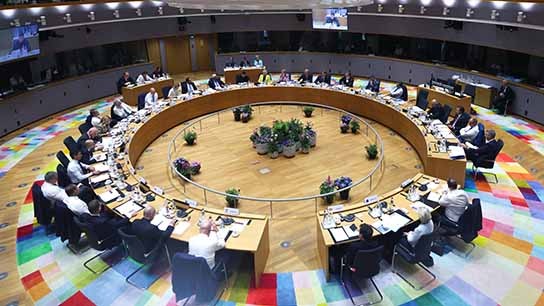
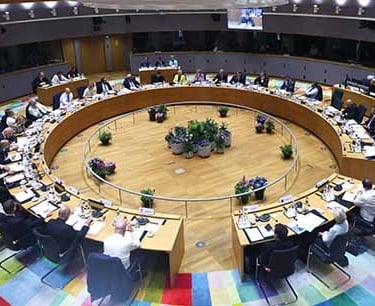
On 19 June 2026, the leaders of the European Union's twenty-seven member states sat down in Brussels and signed off on a sixty-two-paragraph document covering Ukraine, Iran, Gaza, defense spending, drug trafficking, and the next seven-year EU budget. Buried near the end, after Ebola and Armenia and a paragraph reaffirming support for international courts, sits paragraph 61. It is one sentence long.
"The European Council takes note of the Commission Communications on an 'EU strategy for islands' and on an 'EU strategy on resilient, prosperous and liveable coastal communities.'"
That is the entire conclusion. No targets, no funding figures, no enforcement mechanism — just an acknowledgment that the Commission has produced two strategy documents and the Council has read them. In the grammar of European Council conclusions, "takes note of" is one of the softest verbs available, well below "welcomes," "calls for," or "underlines." It is the language leaders use when they want a paragraph in the record without committing to anything in particular.
A few hundred kilometers southeast of the room where that sentence was agreed, on the Albanian Riviera, the test of what that sentence is actually worth has been running in real time for months — and it involves, almost too neatly, both halves of paragraph 61 at once: an island, and a coastline.
Five weeks before EU leaders filed paragraph 61 into the record, they had already addressed the Western Balkans directly and more enthusiastically. Paragraph 55 of the same conclusions welcomes the EU–Western Balkans Summit held in Tivat, Montenegro, on 5 June 2026, describing it as having "contributed to the new impetus in the enlargement process," and reiterating that the EU "will continue to work closely with the Western Balkans and support their reform efforts on their paths towards EU membership." President António Costa, briefing reporters after the June summit, pointed to "the positive momentum created by progress with Montenegro and Albania" as part of the backdrop that helped pave the way for opening accession talks with Ukraine and Moldova the same week — Albania cited, by name, as evidence that enlargement is working.
That momentum was being celebrated in Tivat at almost exactly the moment a different scene was unfolding on Albania's own coast. In the weeks before and after the summit, developers working on a $1.6 billion resort project linked to Jared Kushner's investment firm, Affinity Partners, erected a barbed-wire fence across part of the beach at Zvërnec, inside the Vjosa-Narta protected wetland — the same landscape Albania has spent years presenting internationally as a conservation triumph. The fence cut off public access to a stretch of coastline that residents and tourists had used freely. After video of the fence circulated and protests began, it came down. The episode, brief as it was, captured something no Council conclusion mentions by name: enlargement "momentum" and coastal land grabs were happening on the same beach in the same season.
By the time EU leaders met in Brussels in June, the dispute had grown far beyond a fence. Thousands of Albanians had marched through Tirana carrying inflatable flamingos, chanting "Albania is not for sale." Police had used water cannon on protesters. Anti-corruption prosecutors had opened an investigation into how the underlying land titles for the Kushner-linked project were acquired and had frozen a developer's bank accounts. A Greek citizen was injured in a clash with private security at the fenced site, prompting a formal protest from Athens — a NATO ally and fellow EU member objecting to events inside a country the EU was simultaneously praising for its reform momentum. None of that appears in the European Council's conclusions. It did not need to. The Council's text deals in aggregates and strategies; the consequences of those strategies show up later, in places like Zvërnec.
Paragraph 61 mentions an "EU strategy for islands" in the same breath as the coastal-communities strategy, and the pairing is not incidental to this story — it is the story, almost literally. The same $1.6 billion development controversy convulsing Albania centers as much on an island as on a coastline: Sazan, a 1,400-hectare former Soviet military base at the mouth of the Adriatic, which Kushner's wife, Ivanka Trump, has described discovering by swimming ashore from a friend's boat and hiking it barefoot. Affinity Partners' plans for Sazan — luxury hotels on a once-secret military island, paired with a parallel development around the Narta lagoon at Zvërnec — are the twin halves of the same project that triggered the protests, the fence, and the prosecutorial investigation.
The EU's own islands strategy exists to address exactly the vulnerabilities Sazan now embodies in miniature: small, ecologically fragile landmasses with limited governance capacity, attractive to exactly the kind of high-value, low-oversight investment that can outrun a country's planning institutions before they notice. Sazan is not yet inside the EU and the islands strategy does not bind Albania. But it is difficult to read a Council communication naming "islands" as a policy category requiring dedicated EU support, and not notice that the most prominent island currently under EU-candidate jurisdiction is, this month, surrounded by riot police rather than conservation planners.
The Commission's "EU strategy on resilient, prosperous and liveable coastal communities" exists because coastal Europe — from the Algarve to the Aegean — has spent decades absorbing the costs of tourism-led development that outran the planning and environmental review meant to govern it. The strategy's premise is that coastal regions need targeted support to manage exactly the pressures now visible in Albania: land speculation, habitat loss, overtourism, and the gap between a region's ecological carrying capacity and the investment flowing toward it.
Albania is not yet a member state, so the strategy does not bind it directly. But Albania is a candidate country whose entire accession file rests on demonstrating that it can absorb and enforce EU rules before it joins — including the environmental impact assessment, strategic environmental review, and public consultation requirements that sit underneath the Birds Directive, the Habitats Directive, and the Bern Convention. The Vjosa-Narta wetland, where the Kushner-linked project and at least two other large undisclosed resort masterplans — UMEA and New Apollonia, commissioned for the Balfin Group and revealed by the investigative outlet Citizens.al — are all concentrated, is precisely the kind of landscape those rules exist to protect.
The Bern Convention has already pressed Albania over construction near Vlora's airport inside that same protected landscape. EuroNatur and the BirdLife-affiliated PPNEA say recent works there proceeded without transparent review or public consultation. PPNEA's executive director, Aleksandr Trajçe, has said publicly that "from start to finish there has been a total lack of transparency" around the resort plans encroaching on the wetland. None of that has stopped Balfin's own marketing materials from describing one of the undisclosed projects, New Apollonia, in the present tense, as a live "coastal city" open to international investors — a description that contradicts the company's own account to journalists that the project was nothing more than an abandoned trade-fair concept. Balfin did not respond to a request for comment on that contradiction.
This is the texture a one-line Council conclusion cannot capture: not a single bad project, but a pattern — companies, masterplans, fences, and protests — accumulating in the exact landscape the EU has flagged for special protection, in the exact country the EU is currently fast-tracking toward membership.
"Reversible" has a precedent, and it is not encouraging
Paragraph 55 contains a phrase that deserves more attention than it usually gets: the European Council "remains committed to advancing the gradual integration between the European Union and the region during the enlargement process itself in a merit-based and reversible manner." Reversible is the operative word, and it is not new rhetoric invented for the Western Balkans. The EU has used a version of this mechanism before, and the precedent is instructive rather than reassuring.
Serbia has held formal candidate status since 2012 and opened accession negotiations in 2014. More than a decade later, several of its negotiating chapters remain frozen, explicitly tied to backsliding on rule-of-law benchmarks the Commission says Belgrade has failed to sustain. The "merit-based and reversible" language exists precisely because Brussels learned, watching Serbia, that momentum granted at a summit can curdle years later if a candidate's on-the-ground practice diverges from the commitments that earned the momentum in the first place. The mechanism is real. What has historically been slow, in Serbia's case and others, is Brussels' willingness to actually invoke it against a politically useful or geographically prized candidate before the divergence becomes undeniable.
Albania's environmental governance around Vjosa-Narta is, on the available evidence, exactly the kind of divergence that mechanism was built to catch — and exactly the kind Brussels has historically been slowest to act on. The country has banked enormous diplomatic credit by declaring the Vjosa Europe's first Wild River National Park in 2023, a decision praised from Brussels to Berlin and cited repeatedly as proof of Albania's environmental seriousness. But the park's boundary, drawn the same year, stopped short of the delta and the coastal wetlands around it — the same ground where the undisclosed masterplans and the Kushner-linked project are now concentrated. Conservationists have argued for years that this exclusion was not an oversight but a choice, made with the benefit of hindsight to look very much like room left open for exactly the kind of development now underway. Riverwatch's Ulrich Eichelmann, one of the river's most prominent international defenders, has described the pattern bluntly: greenwashing, in his words — "the zone is presented as in harmony with nature, but in reality it is something else entirely" — and he has said he expects more of it, not less, to follow Kushner's project specifically.
Whether Brussels treats Vjosa-Narta as a footnote or a test of the "merit-based and reversible" language it just reaffirmed is not yet clear, and the timeline for finding out is short. The European Council has scheduled a "strategic discussion on enlargement and reforms" for its next meeting, in October 2026 — the same month it will also take stock of the broader competitiveness and Multiannual Financial Framework negotiations, and the same month by which member states are meant to have an overall budget agreement to keep EU funding flowing without interruption from January 2028. October, in other words, is shaping up as the moment several of the EU's enlargement-era promises come up for a real accounting, not just a press conference.
Albania's government has so far treated the controversy as a public-relations problem to be managed rather than a governance failure to be corrected. Prime Minister Edi Rama, defending the Kushner-linked project on American television, told critics it was "not your fight." That posture — sovereignty as the rebuttal to scrutiny — is itself a familiar feature of accession politics: candidate governments learn quickly that the cost of ignoring conservation groups and domestic protesters is usually lower than the cost of disappointing whichever investor currently anchors the country's growth narrative, at least until Brussels signals otherwise. So far, Brussels has not signaled otherwise. Paragraph 61 took note of a strategy. It did not take note of Zvërnec.
There is nothing unusual about a European Council conclusion being vague. Most of them are, by design — written to record consensus among twenty-seven governments rather than to resolve any one country's specific dispute. Paragraph 61's softness is not evidence of bad faith; it simply reflects that the Commission's coastal-communities and islands strategies are new, aggregate, and not yet operational anywhere, let alone in a candidate country that isn't bound by them yet in the first place.
But the distance between that paragraph and Zvërnec is still worth naming, because it is the distance candidate countries are routinely allowed to occupy during accession: praised in summits, monitored in strategy documents, and largely left to their own institutions to police in the meantime. The strategy papers paragraph 61 references will, eventually, set out funding lines and resilience metrics for coastal and island communities across the Union. None of that architecture currently reaches Sazan or Zvërnec, and nothing in this month's conclusions suggests it is about to.
The European Council will reconvene on enlargement in October. By then, the masterplans for UMEA and New Apollonia may still be exactly where Balfin says they are — shelved concepts from a real-estate fair in Munich — or they may not be. The fence at Zvërnec came down once already. Whether it, or something like it, goes back up before October, and whether anyone in Brussels treats that as relevant to Albania's "merit," is the more immediate test of what one quiet paragraph is actually going to mean.
This article draws on the European Council conclusions of 18–19 June 2026 (EUCO 8/26) and President António Costa's press remarks of the same date, both official EU documents; reporting on the Kushner-linked Sazan/Zvërnec resort from Reuters, The Guardian, Al Jazeera, Time, OCCRP, the Times of Israel and Democracy Now!; reporting on the UMEA and New Apollonia masterplans from Citizens.al, supplemented by independent review of Balfin's public real-estate marketing materials; and publicly available reporting on the status of Serbia's EU accession chapters, cited here as historical context for the EU's "reversible" enlargement mechanism. Balfin, MVRDV and WATG were contacted by email regarding the contradiction described above and did not respond by the time of publication.