Off the Record: Inside the Server Leak That Exposed Peter Thiel's Secret Society
How a misconfigured website pulled back the curtain on Peter Thiel's secret society — and what it actually showed us about power in 2026
Off the Record: Inside the Server Leak That Exposed Peter Thiel's Secret Society
How a misconfigured website pulled back the curtain on Peter Thiel's secret society — and what it actually showed us about power in 2026
For twenty years, Dialog didn't exist. Not in any way you could search for, anyway.
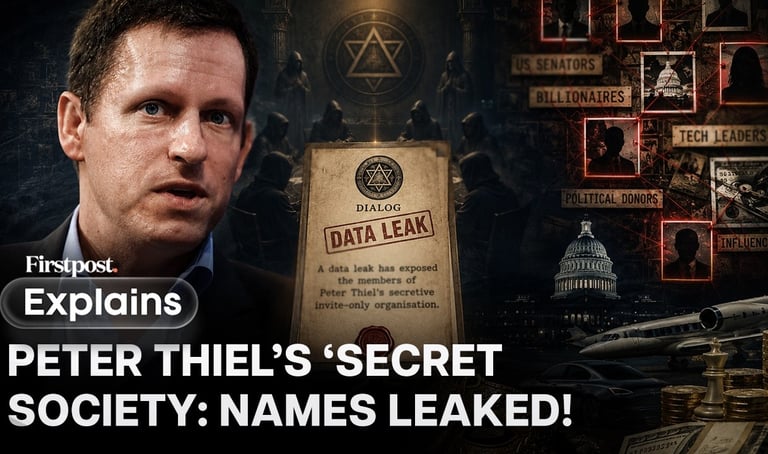
No website worth finding. No public roster. No press office. Founded in 2006 by Peter Thiel and Silicon Valley investor Auren Hoffman, the invitation-only retreat built its entire identity on the idea that the most powerful people in the world need a room where nobody is performing for cameras. Off the record. No panels, no speeches — just small, moderated breakout conversations among people who, as the group's own member guide puts it, are asked to "offer a dissenting view" and avoid "status signaling."
That mystique survived two decades. It did not survive a misconfigured server.
Earlier this month, a Swiss security researcher who goes by maia arson crimew — best known for exposing the U.S. government's no-fly list in 2023 — discovered that Dialog's website was leaking data it was never supposed to show the public. Member directories. Phone numbers. Email addresses. Emergency contacts. Political-leaning surveys. Personal "fun facts." Predictions for the year 2031. And a full session list for the group's planned August retreat in Dublin.
Crimew passed the material to multiple outlets, including The Hollywood Reporter and Straight Arrow News. What came out wasn't a conspiracy. It was a guest list — and the guest list alone was the story.
Who's in the room
The names span sectors that don't normally share a dinner table. Treasury Secretary Scott Bessent. Senator Ted Cruz. Former Xbox president Sarah Bond. OpenAI president Greg Brockman. Google vice president Lisa Gevelber. Anthropic's global affairs chief, Michael Sellitto. Fortress Investment Group's Pete Briger. Elon Musk. Jared Kushner. Longevity entrepreneur Bryan Johnson. Podcaster Sam Harris.
Hollywood turns up too, more than anyone might expect from a group built around AI and geopolitics: actors Josh Brolin, Joseph Gordon-Levitt and Sophia Bush; A24 partner Scott Belsky; La La Land composer-producer Benj Pasek; Hybe America chairman and CEO Isaac Lee; Family Guy writer-producer Teresa Hsiao; The Atlantic CEO Nicholas Thompson; and New York Times columnist Ezra Klein.
The leaked vetting files show Dialog grades prospective members the way a college admissions office might. Hsiao received an A grade; her internal dossier praised her as part of "the increasing diversity in television and film, showcasing stories that might not have been told previously." Brolin, a first-timer, got a C. His own submitted bio — apparently written without much concern for what the vetters wanted to hear — read in part: "I grew up on a horse farm, climbed parts of Everest, given academy awards, been nominated, written a book... and smoked crack under a car at 3am in San Francisco." Told later that his data had leaked, a spokesperson for Brolin said the actor would "like to know what the fuck he got himself into."
Not everyone named in the data has confirmed they belong there. A spokesperson for Colorado Governor Jared Polis pushed back directly, telling The Hollywood Reporter that "he does not know why his name is associated with the organization in any way or appeared on their website" and that he had not previously heard of Dialog. That denial is worth sitting with: the leak shows who Dialog says is connected to it, not necessarily who would claim the connection themselves.
What they actually talk about
The leaked agenda for Dublin reads like a fever dream of 2026's anxieties. Sessions titled "Bring Back Nuclear." "Disinformation & Deepfakes." "Battlefield Technologies." "Democracy Under Surveillance." "Taiwan and the AI Race." "Three Predictions for Iran." "Navigating WWIII."
And then, wedged between geopolitics, the personal: "Build-a-Party." "How's Your Sex Life." "It's Fun to Be in Charge." "Research-Based Longevity Hacks." A member guide instructs attendees to stay concise, challenge the room, and resist the urge to recite their résumés — "only share those aspects of your bio that are most relevant to the conversation or to people getting to know you."
It is, by design, a place where a venture capitalist and a sitting senator might debate AI policy over dinner and then, an hour later, discuss whether money buys happiness. According to one industry analysis, the gathering draws bi-partisan, albeit heavily libertarian-leaning, representation from US congressional and senatorial figures, intelligence and defense officials, and European leaders concerned with digital sovereignty, alongside psychologists and logicians — with the gravitational center being, in that analysis, the architects of the new defense and artificial intelligence industries, named as Palmer Luckey, Alex Karp, Elon Musk, and figures tied to Andreessen Horowitz and Founders Fund.
Dialog isn't staying nomadic, either. The organization purchased land outside Washington, D.C. last year for a permanent campus — close enough to Langley and the Pentagon that one NATO-affiliated analyst read it as a deliberate signal that the group is moving from informal retreat to institutional fixture, with deeper engagement with lawmakers to follow.
The man behind it
Thiel himself remains the gravitational figure, even when he's not in the room. Co-founder of PayPal, founder of Palantir Technologies, a vocal backer of Vice President JD Vance — Thiel has spent two decades occupying the exact intersection Dialog is built to explore: Silicon Valley capital, defense technology, and political influence. He has donated more than $1.7 million to candidates and parties in a single recent election cycle, according to federal filings, and has said openly that he no longer believes freedom and democracy are compatible. A spokesperson for Thiel did not respond to a request for comment on the leak.
Asked about the breach, crimew offered a blunter diagnosis than any think-tank report could: "It's just wild to me how this once again shows that the people who run the world are so confident in their safety that they don't really bother with any proper operational security."
What this isn't
Here's the part responsible reporting requires saying plainly: this leak does not prove that Dialog runs anything. It is not a shadow government, and nothing in the exposed data shows the group issuing directives, coordinating votes, or steering specific deals. What it shows is something more mundane and, in its way, more revealing — that a remarkable number of people who separately sit on AI labs' boards, in cabinet seats, on studio lots, and inside intelligence agencies also sit, a few times a year, in the same room, off the record, talking about the same handful of things keeping them up at night.
That's not a smoking gun. It's a map of relationships. Whether candid, cross-sector conversation among the powerful is a healthy release valve or a transparency problem depends entirely on who you ask — and the leak didn't settle that argument. It just confirmed, for the first time with names attached, that the argument is about something real.
What happens next — whether Dialog tightens its security, whether the Dublin retreat proceeds as planned, whether any of the named figures clarify their involvement beyond Polis's denial — is the next chapter. For now, the guest list speaks for itself.
Sourcing note: This piece draws on leaked Dialog membership and session data first reported by The Hollywood Reporter (Winston Cho) and Straight Arrow News (Mikael Thalen), alongside analysis published by the NATO Defense College Foundation. Quoted material is drawn directly from those published reports. Anthropic, whose global affairs chief is named in the leaked data, is the company behind this writing assistant; that affiliation is disclosed here for transparency.