Flamingos and Frontrunners: How Brussels Praised Albania While Bulldozers Worked the Coast
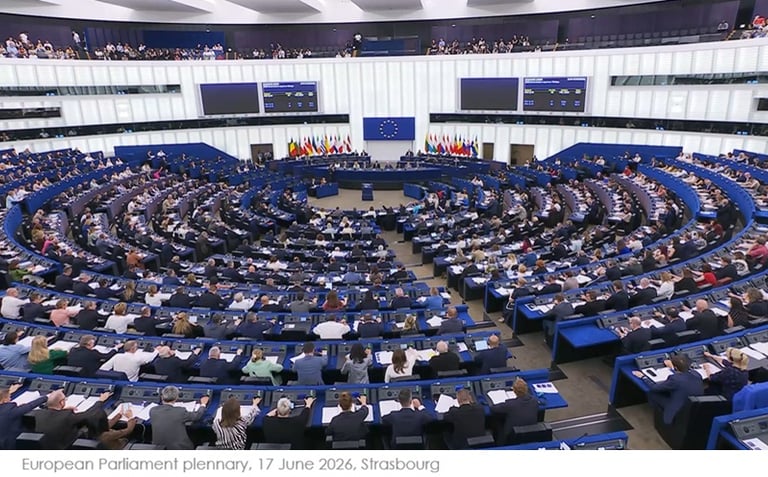
On the afternoon of June 17, the European Parliament did what it has done for nearly two decades whenever a Balkan candidate inches toward Brussels: it voted to applaud. Four hundred and eighty-three lawmakers raised their hands for Albania, declaring the country an "outstanding" performer in the EU's enlargement race, a nation that had — almost alone among its neighbors — opened all thirty-three negotiating chapters in just thirteen months.
Flamingos and Frontrunners: How Brussels Praised Albania While Bulldozers Worked the Coast
By [Your Byline] — June 2026
STRASBOURG/TIRANA — On the afternoon of June 17, the European Parliament did what it has done for nearly two decades whenever a Balkan candidate inches toward Brussels: it voted to applaud. Four hundred and eighty-three lawmakers raised their hands for Albania, declaring the country an "outstanding" performer in the EU's enlargement race, a nation that had — almost alone among its neighbors — opened all thirty-three negotiating chapters in just thirteen months.
One hundred and three voted against. Seventy abstained.
Three hundred kilometers away, on a spit of land where the Vjosa River dissolves into the Adriatic, bulldozers had already spent six weeks tearing through one of the last untouched wetlands in the Mediterranean — without a permit, without an environmental review, and, according to Albanian environmental groups, after the government gave parliament an account of events that didn't match what was happening on the ground.
The two facts sat uneasily beside each other all week. And buried inside the very resolution that congratulated Tirana was a paragraph most headlines missed: a demand that Albania immediately freeze construction in its protected areas and repeal the law that made the bulldozing legal in the first place.
This is the story of how the European Union's two main institutions — its elected Parliament and its appointed Commission — ended up, within 48 hours of each other, giving Edi Rama's government two very different verdicts on the same set of facts.
The Vote
The resolution, formally titled the 2025 Commission report on Albania (A10-0141/2026), was the product of months of negotiation led by Austrian MEP Andreas Schieder, a Social Democrat who has shepherded Albania's file through Parliament for two years. Schieder calls Albania "the second frontrunner" in the enlargement race, behind only Montenegro, and during the debate on June 16 he said the country's goal of closing accession talks by 2027 "no longer appears to be a dream but rather a realistic prospect."
Commissioner for Enlargement Marta Kos, addressing the same chamber, struck an almost triumphant note about the broader region: there is, she said, "a window of opportunity" for the whole Western Balkans to advance — provided governments deliver on reforms and align with EU foreign policy.
It would have been an unremarkable instance of Brussels enlargement choreography, except for one thing. Schieder, in the same speech praising Albania's reform pace, inserted a warning that read almost like a rebuke aimed at a specific hillside on the Albanian coast: tourism, he said, creates jobs and growth "only in the long term if nature and the environment are not sacrificed in the process," and he said he expected EU rules on habitat and bird protection to be "fully respected."
He did not name the project. He didn't need to.
How the vote actually broke down
A roll-call analysis of the vote — compiled from European Parliament records and the open-data project HowTheyVote.eu — shows that the 103 "against" votes were not, in the main, a verdict on Albania's record. They were a referendum on enlargement itself.
The pro-integration center — the European People's Party, the Socialists and Democrats, Renew Europe, and the Greens — voted almost as one bloc: 97%, 99%, 100%, and 100% in favor, respectively. Opposition was concentrated almost entirely in the European Parliament's hard-right and Eurosceptic formations: the Patriots for Europe group voted 71% against, the smaller Europe of Sovereign Nations group voted against unanimously, and non-attached MEPs split heavily against or abstained.
France was the only major EU member state where "against" outpolled "for" — 47% against versus 36% in favor, a reflection of how French nationalist parties are distributed across the Parliament's right-most blocs. Italy, by contrast — a country with its own considerable financial stake in Albania through the Meloni government's migrant "return hub" centers in Shëngjin and Gjadër — voted 86% in favor with zero MEPs against.
The most telling abstention came from the radical-left grouping, The Left, which voted 84% to abstain rather than oppose outright — a position that reads less as enlargement skepticism than as discomfort at being asked to bless a government facing corruption probes and a domestic uprising over land deals.
In other words: the numbers tell a story about Europe's internal politics far more than they tell a story about Albania.
What the topline vote count obscured is that the resolution itself was not a simple love letter. Tucked into its operative paragraphs was language environmental groups had been demanding for weeks: a call for Albania to repeal the 2024 amendments to its Law on Protected Areas, and to impose "an immediate moratorium on new permitting procedures, construction works and development interventions within protected areas" until full compliance with EU nature law is restored.
The target of that paragraph has a name, even if the resolution doesn't use it: Sazan Island and the Pishë Poro–Narta lagoon, where a luxury resort backed by Jared Kushner — the son-in-law of US President Donald Trump — and his wife Ivanka Trump has become the most explosive political controversy in Albania in a generation.
The legal mechanism behind the project is traceable to a single piece of legislation. In February 2024, Rama's government pushed Law No. 21/2024 through parliament, amending the national Law on Protected Areas to create a new category — "excellence tourism" — permitting large hospitality developments inside zones that had previously been off-limits to anything but light-footprint tourism. It is this law, and not any single building permit, that environmental NGOs and now the European Parliament want repealed.
The protected landscape in question is not a minor wetland. The Vjosa–Narta delta is part of the last fully intact river-delta system left in the Mediterranean. It hosts more than 200 bird species and over 70 threatened species, sits squarely on the Adriatic Flyway used by millions of migratory birds each year, and shelters two of Europe's most endangered marine animals, the Mediterranean monk seal and the loggerhead sea turtle — species that EU member states Greece, Italy and Croatia are themselves legally bound to protect. In 2025, UNESCO recognized the broader Vjosa Delta as a Biosphere Reserve. It is also a candidate site for the Emerald Network under the Bern Convention, and is slated to join the EU's Natura 2000 network the moment Albania becomes a member.
None of that protected status stopped what happened starting in early May 2026: trucks, bulldozers and earthmoving equipment arrived in the protected zone. According to monitoring by the Albanian conservation group PPNEA and BirdLife International, there was no published project description, no environmental impact assessment, no public consultation and no valid construction permit. At one point, work blocked one of only two channels connecting the Narta Lagoon to the open sea — severing the tidal exchange that the entire ecosystem depends on. Conservationists say the damage to centuries-old sand dunes, classified as Natural Monuments under Albanian law, will take centuries to reverse.
When members of the Albanian parliament asked what was happening, the government's answer — that the lagoon channel had been closed to build an access road for "environmental surveying" — did not match what investigators and journalists found on the ground, according to BirdLife International's published findings.
This was not, environmental groups point out, the first time the same protected landscape had been compromised by a major infrastructure project. Construction of Vlora International Airport began inside the same protected landscape in November 2021, and the Bern Convention's Standing Committee asked Albania to suspend that project as early as 2023 — a request Tirana did not heed.
Two Institutions, Two Stories
The most striking thing to emerge from a close reading of the week's record is not the protest movement, the resolution, or even the bulldozers. It's the daylight between what the European Commission was prepared to say about Vjosa-Narta and what the European Parliament was prepared to say two days later, about the identical set of facts.
On June 15, at a press conference, Commissioner Kos told reporters the Commission had "received guarantees from the Government of Albania that a full Environmental Impact Assessment will be carried out and that European environmental standards will be respected." It was a statement that accepted Tirana's word for it, at a moment when, by environmental groups' own documentation, the illegal works were already six weeks old.
PPNEA's response was scathing. The Commissioner's position, the group said, rested on "inaccurate information and political guarantees" from the same government whose construction crews had already done the damage — without permits, without protective measures, without transparency. The organization called on the Commission to demand an outright ban on activity at the site until legal compliance could be verified, not merely accept assurances.
Two days later, the Parliament did something closer to what the NGOs had asked for. Its resolution didn't just note the controversy — it called explicitly for repeal of the 2024 law and an immediate construction moratorium, plus a separate expression of "deep concern" over Albania's Law on Strategic Investments, the fast-track permitting regime that critics say allows large projects to sidestep environmental review altogether.
BirdLife International's verdict on the gap between the two institutions was blunt: "the Parliament has shown more commitment than the Commission in defending EU laws."
Anouk Puymartin, BirdLife Europe's policy director, framed the stakes for accession itself: EU membership, she argued, cannot be built on promises and communication strategies — it has to be built on enforcement of the law as written.
PPNEA's Aleksandër Trajçe placed the episode in a larger frame, arguing that the fight over a single Albanian lagoon had become a proxy for a much bigger question hanging over the entire enlargement process: whether Brussels' rule-of-law standards mean anything in practice, or only on paper. It is worth remembering what was happening in Tirana while all of this institutional back-and-forth unfolded in Strasbourg's chamber.
By the week of the vote, what locals and international press now call the "Flamingo Revolution" — named for the inflatable pink birds protesters carry, and the real flamingos that nest in the threatened lagoon — had stretched past eighteen consecutive days. More than 100,000 people had taken to the streets of Tirana and other Albanian cities at various points, with diaspora solidarity protests reported in cities from New York to Sydney. What began as an environmental campaign against a single resort metastasized, in the space of weeks, into a broader movement accusing Rama's government of corruption, cronyism, and selling off national assets to foreign and Gulf capital. Demonstrators have called, consistently, for Rama's resignation.
MEP Ilaria Salis, addressing the chamber during the June 16 debate, told colleagues that Europe should watch Albania closely — arguing that an engaged, mobilized public is itself one of the strongest guarantees a country can offer on its path toward EU membership.
Rama's own response to the resolution, by multiple accounts, came via a social media post dismissing the uproar and offering a one-line assurance that the flamingos would be protected — a register strikingly smaller than the gravity of what his own parliament, and now the European Parliament, were being told about the site. Days later, on June 25, he posted again, telling supporters that no force could stop his government, his party, and Albania's citizens from reaching EU membership by 2030, and dismissing the demonstrations as unrepresentative of the country as a whole. He has separately attributed the unrest to "manipulated" extremist elements and to foreign cyber interference — claims he has not substantiated publicly.
By the time of the Parliament vote, under sustained street pressure rather than government enforcement, construction fencing at the Vjosa-Narta site had reportedly come down and work had been suspended, at least temporarily.
Strip away the press-release language on both sides, and the documentary record assembled here points to a few hard conclusions:
First, the European Parliament's praise for Albania's accession pace is genuine and bipartisan across its pro-EU center — but it is not unconditional, and the resolution's environmental paragraphs are, in substance, a formal rebuke of a specific government decision (the 2024 protected-areas law) tied to a specific, named controversy, even though no MEP said "Kushner" or "Sazan" on the record.
Second, the "against" vote tally that drove headlines was overwhelmingly a story about Europe's own internal politics — the rise of hard-right, anti-enlargement blocs — rather than a verdict on Albania's specific conduct. Reporting that frames 103 votes against as "criticism of Albania" without the group breakdown misses the actual story.
Third, there is a documented, on-the-record gap between the Commission's accommodation of Tirana's assurances and the Parliament's demand for verified compliance — a split that environmental groups, not EU officials, were the first to put on record, and one that raises a real question about which EU institution actually enforces accession conditionality when push comes to bulldozer.
Fourth, the underlying legal mechanism — Albania's 2024 "excellence tourism" carve-out — is not limited to one resort. It has already enabled a second major land dispute, the "Blue Borgo" project in Rrjoll backed by Albanian businessman Bashkim Ulaj, suggesting a structural pattern rather than an isolated controversy.
The European Parliament will revisit Albania's progress again before the year is out. The General Affairs Council is expected to consider provisionally closing three more negotiating chapters — Science and Research, Education and Culture, and External Relations — at its meeting on July 14. Whether the chapter most directly at stake in Vjosa-Narta, Chapter 27 on the Environment, can close on anything like that timeline now depends less on a press conference in Brussels than on whether the bulldozers stay parked.
This article is based on official European Parliament voting records, the adopted text of resolution A10-0141/2026, European Commission statements, and on-the-record statements from PPNEA, BirdLife International, BirdLife Europe, and European Western Balkans, among other sources documented in the reporting record.