Europe's Enlargement Moment Has Arrived — But Can the Western Balkans Seize It?
Europe's Enlargement Moment Has Arrived — But Can the Western Balkans Seize It?
Europe's Enlargement Moment Has Arrived — But Can the Western Balkans Seize It?
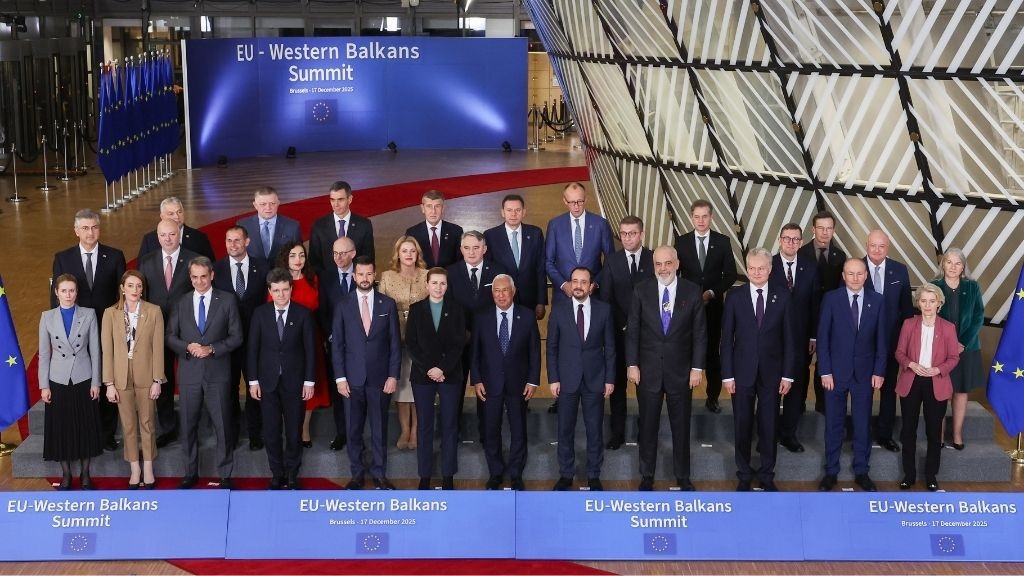
At the EU–Western Balkans Summit in Montenegro, António Costa signalled that enlargement is no longer a distant aspiration but an active geopolitical project. The challenge now lies with both Brussels and the region.
By Spartak Fikaj
TIVAT, Montenegro — For more than a decade, European leaders repeatedly assured the countries of the Western Balkans that their future lay within the European Union. Yet for many citizens across the region, those promises increasingly sounded like diplomatic ritual rather than political reality. Accession negotiations moved slowly, reform requirements multiplied, bilateral disputes blocked progress, and enlargement gradually disappeared from the top tier of European priorities.
At the EU–Western Balkans Summit held in Tivat on 5 June, European Council President António Costa sought to send a different message. Speaking alongside regional leaders after a week-long tour of the Western Balkans, Costa repeatedly returned to a theme that has become increasingly visible in Brussels over the past year: enlargement is back at the centre of European strategy.
His remarks were notable not because they repeated the European Union's commitment to enlargement, but because they contained something that has often been missing from previous declarations — concrete evidence that movement is taking place.
Costa pointed to several developments that would have seemed unlikely only a few years ago. Montenegro's accession treaty is now being drafted. Albania has entered a new phase of negotiations, with the European Commission proposing the closure of three chapters. Serbia has submitted a timetable for electoral and judicial reforms. Ukraine and Moldova are preparing to open their first enlargement cluster. Taken together, these developments suggest that enlargement is no longer being discussed merely as a future possibility but as an active policy process.
For Brussels, this shift reflects a deeper transformation in European strategic thinking. Russia's invasion of Ukraine fundamentally changed the way enlargement is perceived inside European institutions. Prior to 2022, accession policy was often framed as a technical exercise centred on governance reforms, economic convergence and institutional alignment. Today it is increasingly viewed through the lens of security and geopolitics.
When Costa described enlargement as a "crucial geopolitical investment," he was signalling this new reality. The phrase appeared repeatedly throughout the summit and reflects a growing consensus among European policymakers that integrating neighbouring democracies is not simply an act of solidarity but a strategic necessity. In a period marked by Russian aggression, growing global competition and increasing uncertainty about the future international order, the European Union views stability in the Western Balkans as directly connected to stability within the Union itself.
The summit therefore revealed an important evolution in Brussels' approach. The European Union is no longer asking the countries of the Western Balkans to wait outside its structures until the moment of formal accession. Instead, it is attempting to integrate them gradually into selected areas of European policy and economic life before membership is achieved.
This approach was visible in discussions surrounding the Growth Plan for the Western Balkans, launched in 2023. The initiative combines financial assistance with economic integration measures designed to accelerate convergence between the region and the European Union. Through access to parts of the Single Market, investment programmes and reform-linked funding, Brussels hopes to create tangible benefits for citizens while maintaining incentives for continued reforms.
One example announced during the summit attracted particular attention. The European Union has formally begun negotiations to extend the "Roam Like at Home" regime to the Western Balkans. Although seemingly technical, the decision carries considerable symbolic significance. If implemented, citizens travelling between the European Union and the Western Balkans would eventually be able to use mobile services without additional roaming charges, bringing one of the most visible everyday benefits of European integration closer to the region.
Yet beneath the optimistic language of the summit lies a more complex reality. Enlargement may have regained political momentum, but significant obstacles remain.
The European Union continues to insist that accession will remain merit-based and dependent on credible reforms. This formulation appears repeatedly in official statements and reflects concerns among member states that the lessons of previous enlargements should not be forgotten. Issues relating to judicial independence, corruption, democratic governance, media freedom and institutional resilience remain central to the accession process.
The challenge is particularly evident in Serbia, where progress continues to be closely linked to democratic reforms and relations with Kosovo. In Bosnia and Herzegovina, political fragmentation continues to complicate reform efforts. North Macedonia remains burdened by disputes that have repeatedly delayed its European path. Kosovo faces its own institutional and diplomatic obstacles. Even Montenegro, widely regarded as the most advanced candidate, still has substantial work to complete before membership becomes reality.
Albania occupies an increasingly interesting position within this landscape. Once viewed as a candidate moving more slowly than some of its neighbours, it now appears among the region's stronger performers. The opening of new negotiation phases and the Commission's proposal to close additional chapters indicate that Brussels sees tangible progress. Nevertheless, the final stages of accession are often the most demanding. Success will depend not only on legislative alignment but on demonstrating sustained implementation of reforms and the strengthening of state institutions.
Another notable aspect of the summit was the emphasis placed on security cooperation. Costa repeatedly stressed the importance of full alignment with the European Union's Common Foreign and Security Policy. Such language reflects growing concerns regarding foreign influence, hybrid threats, cyberattacks and disinformation campaigns targeting the region. The inclusion of mechanisms such as the European Democracy Shield, ENISA cooperation and the Rapid Alert System illustrates how enlargement policy increasingly overlaps with security policy.
This development marks a departure from earlier phases of enlargement. The European Union is no longer focused solely on economic integration and democratic reforms. It is increasingly concerned with strategic resilience. Candidate countries are being encouraged not only to adopt European legislation but also to align themselves more closely with the Union's geopolitical positions and security priorities.
Perhaps the most intriguing element of Costa's remarks was his suggestion that the European Union is considering "new ideas to streamline and accelerate the process." Although he offered no specific details, the statement hints at ongoing discussions within Brussels about how to make enlargement more credible and more politically sustainable. Whether this leads to phased accession, expanded access to EU programmes before membership, accelerated procedures or other institutional innovations remains unclear. What is clear is that both Brussels and candidate countries recognise that the traditional enlargement model faces growing pressures.
The summit in Tivat therefore represented more than another meeting between European and Western Balkan leaders. It offered a glimpse into a changing European strategy. The debate is no longer about whether enlargement should happen. It is increasingly about how quickly it can happen, under what conditions, and in what form.
For the countries of the Western Balkans, this moment presents both an opportunity and a test. The political momentum currently exists. The European Union is investing significant financial, diplomatic and political capital in the region. Yet momentum alone does not guarantee success. Ultimately, accession will depend on whether governments can translate promises into reforms and whether societies can sustain the long-term transformations required for membership.
After years of frustration and uncertainty, the summit in Tivat suggested that enlargement has re-entered the mainstream of European politics. The question now is whether the Western Balkans and the European Union can convert that renewed momentum into one of the most significant geopolitical achievements of the coming decade.